

We Asked Consumers How They Use AI. Maybe We Shouldn’t Have
August 25, 2026
Are We Excited About AI or Terrified of It? Yes.
September 2, 2026
In our last blog, we asked consumers what activities they were using generative AI for. We went a little deeper this time. In our recent wave of research-on-research, we asked consumers which generative AI platform they use for specific tasks. We did this to better understand whether there are tool preferences for specific tasks, or whether tool usage still aligns with each platform’s overall generative AI usage.
Let’s dive in.
The data is based on consumers who reported using generative AI in the past 30 days.
Overall
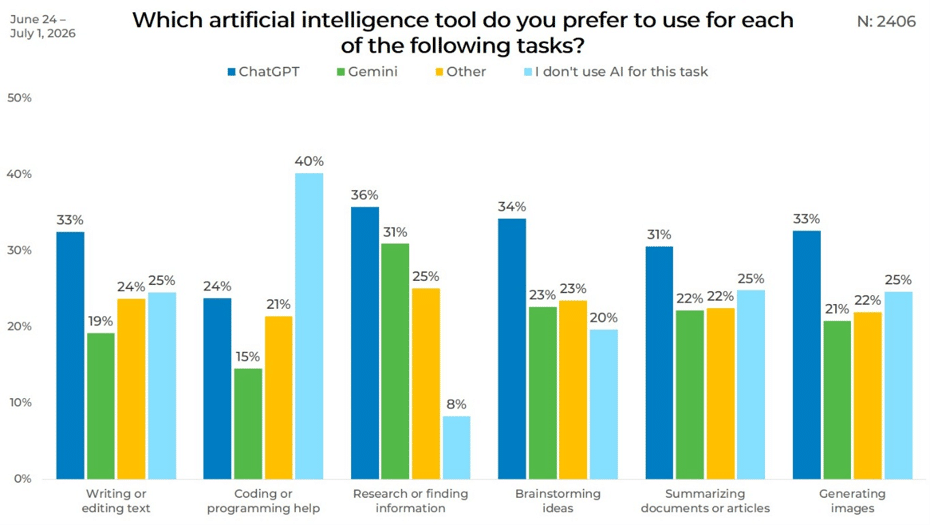
Similar to what we saw when we asked about which generative AI tool consumers use, ChatGPT leads in usage across all 6 tasks. Gemini and Other generative AI tools were second, in most cases having very similar consumer usage for the specific task.
What stood out in the data was that 40% of consumers say they do not use AI for coding or programming help, 16 points higher than those who said they use ChatGPT.
Gender
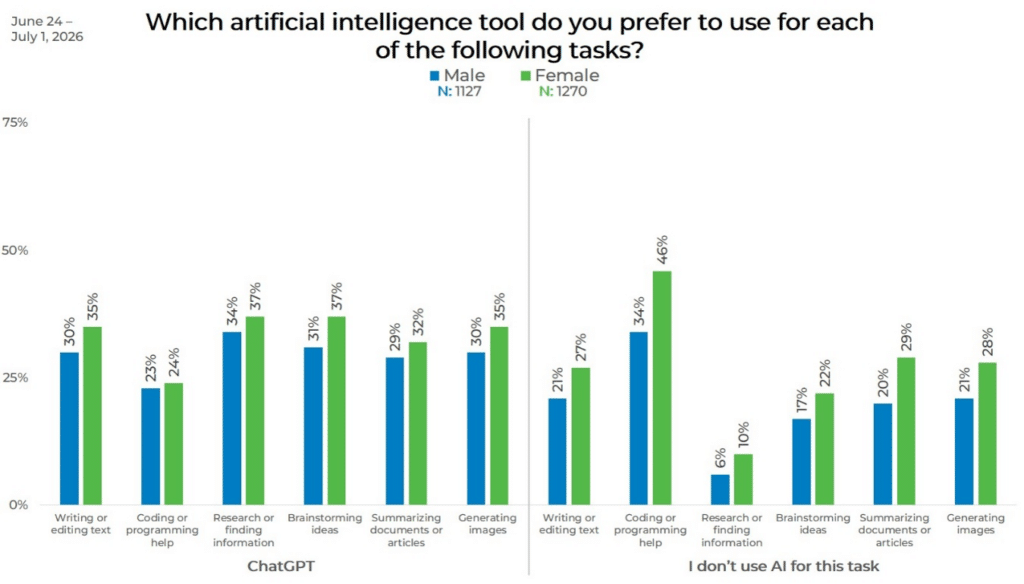
When we have looked at gender-based usage of generative AI, we have always found that males use it more than females. When we segment the data around the specific tool used for tasks, in this case ChatGPT versus not using AI, we found that females are more likely to use ChatGPT for any of the tasks listed than males. These results don’t show that females use generative AI more than males; rather, they show that females use ChatGPT for specific tasks more than males do. Males are more likely than females to use other AI tools for the tasks listed.
We also found that females are more likely than males not to use AI for any of the tasks we listed. The biggest gap between males and females is in coding, where 12% more females do not use AI for this task than males do.
Age
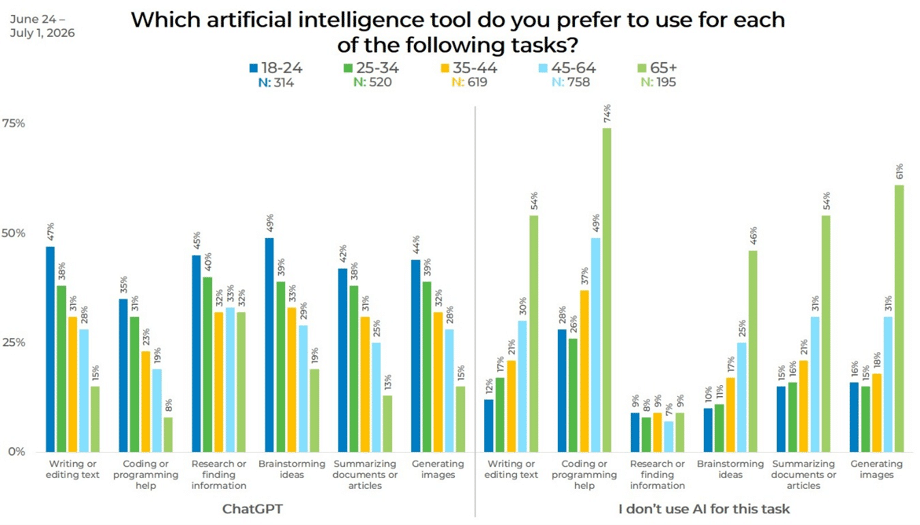
Similar to what we saw when we looked at all generative AI usage across specific tasks, we see that ChatGPT usage for each listed task declines as age increases. The inverse is true for any of the tasks: as age increases, respondents are more likely not to use AI for the listed tasks, except when researching or finding information.
Income
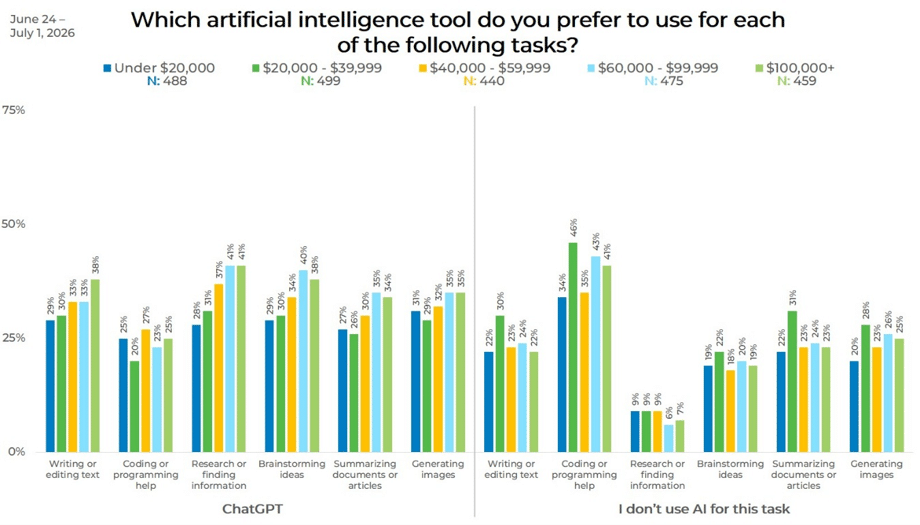
When we segment ChatGPT usage by income level, we see that for most tasks, usage increases with income, except for coding or programming. That task has the lowest ChatGPT usage of any task, and the highest number of respondents at any income level who do not use AI for the task.
Ethnicity
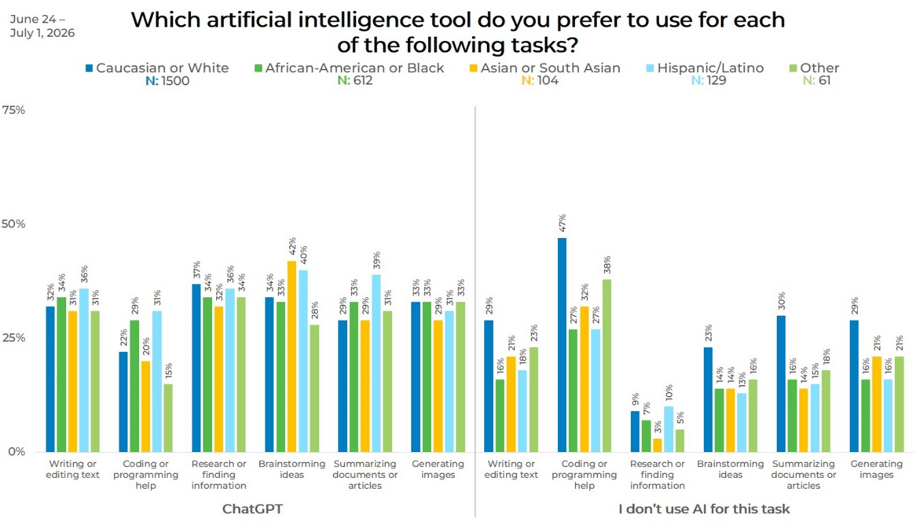
Breaking down ChatGPT usage across listed tasks by ethnicity reveals interesting patterns in the data. Hispanics use ChatGPT for coding at a higher rate than any other ethnicity, and more than 6 percentage points higher than overall.
Hispanics are also among the top 2 or 3 users of ChatGPT for any of the tasks we listed. Caucasians are more likely than other ethnicities to avoid using AI for any of the listed tasks.
Panel
Nothing highlights usage differences for specific tasks as much as breaking the data down by panel source. We found that Panel H has significantly higher ChatGPT usage across all listed tasks; in some cases, it was more than 20 percentage points higher than other panels.
We also found that Panel R has lower ChatGPT usage across many tasks but is in the middle of the pack for tasks where they don’t use AI. Panel K, on the other hand, is the yang to Panel H’s yin. They have the highest percentage of respondents who state they do not use AI for the tasks we listed; for coding, it got as high as 59%.
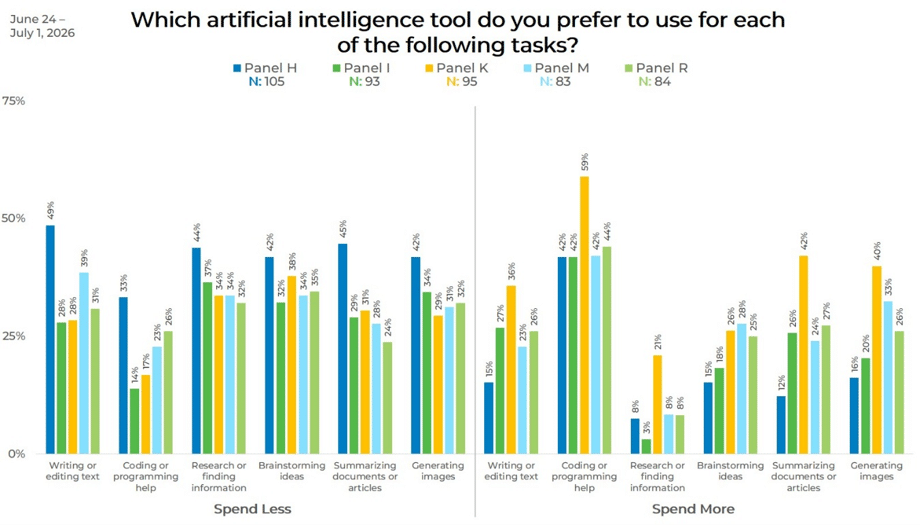
This data highlights the need to build strategic sample plans when conducting online studies. Without strategic blending, your data can become biased, leading to the wrong decision.
To learn how EMI can help you ensure you are making confident business decisions, click the button below.