

Who Knows Generative AI? A Look at Platform Familiarity Across Americans
August 11, 2026
11 Hours of Media a Day and You Want Them to Take Your Survey?
August 18, 2026
If you follow the news, it seems that that more AI tools are being used by more people every passing month. But is this really happening?
In our latest wave of research-on-research, we continued our ongoing research into generative AI usage among US consumers. We wanted to understand if usage is actually following perception of usage.
Let’s dive into the latest results.
Overall
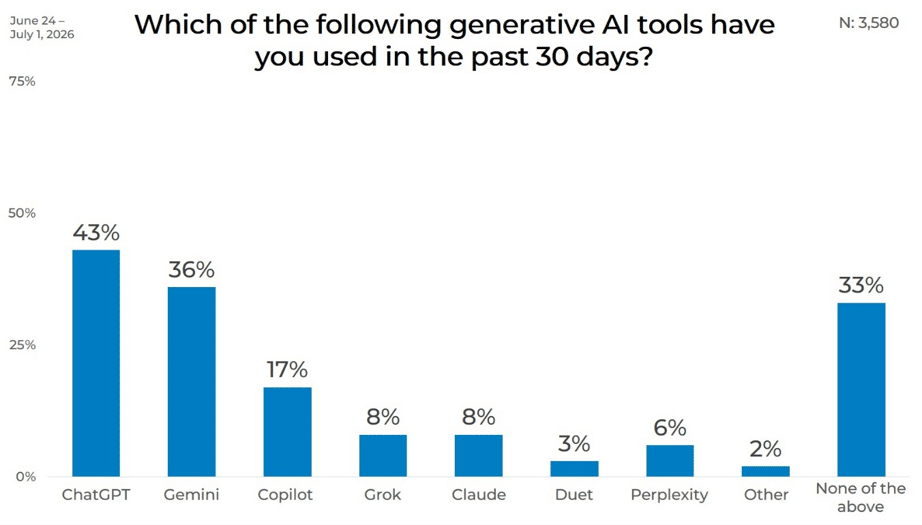
Usage of different generative AI tools varies across consumers. ChatGPT continues to dominate, with 43% of consumers stating they have used it in the last month. Google’s Gemini is second, with 36% of consumers indicating usage. After these two, there is a definite drop in usage, with Grok, Claude, Copilot, Duet, and Perplexity having between 3% and 17% usage among consumers. There is still a large percentage of US consumers (33%) that are not using generative AI tools.
Gender
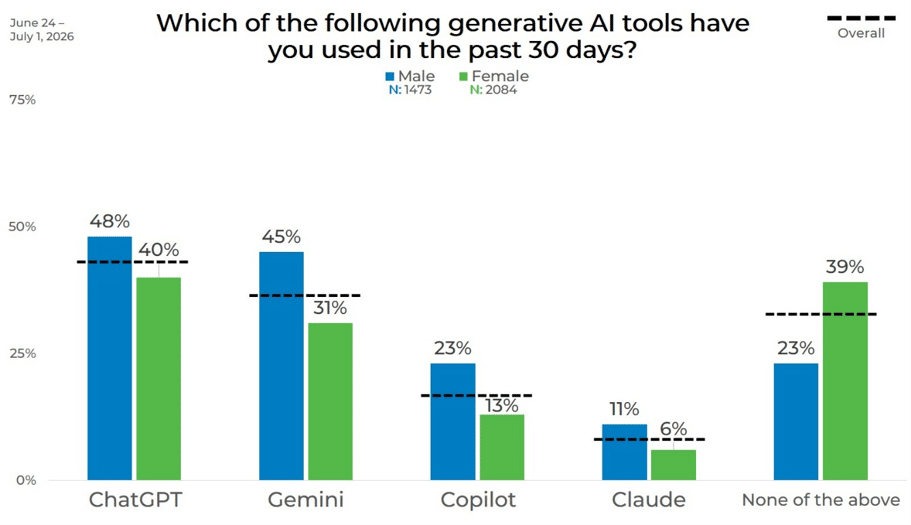
Breaking down the data by gender shows that generative AI usage is higher for men than women across all tools. The gaps between genders range from 5% (Claude) to as high as 14% (Gemini). A significantly larger percentage of women than men report not having used generative AI in the last month.
Age
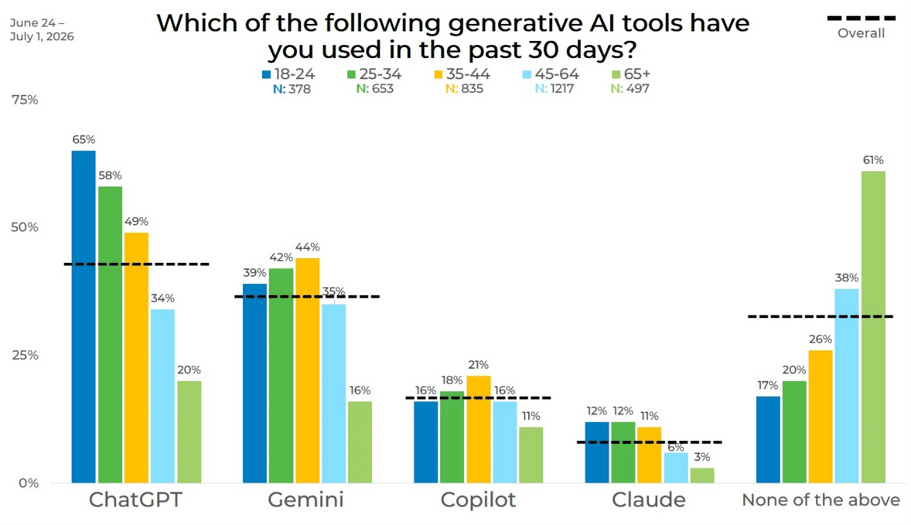
Age highlights some of the clearest differences in generative AI usage. Use of ChatGPT declines with age. Claude is the only other tool that follows this usage pattern.
Both Gemini and Copilot have their usage peak among those aged 35-44, with usage declining as age increases. The decline is much steeper among Gemini users than among Copilot users.
Income
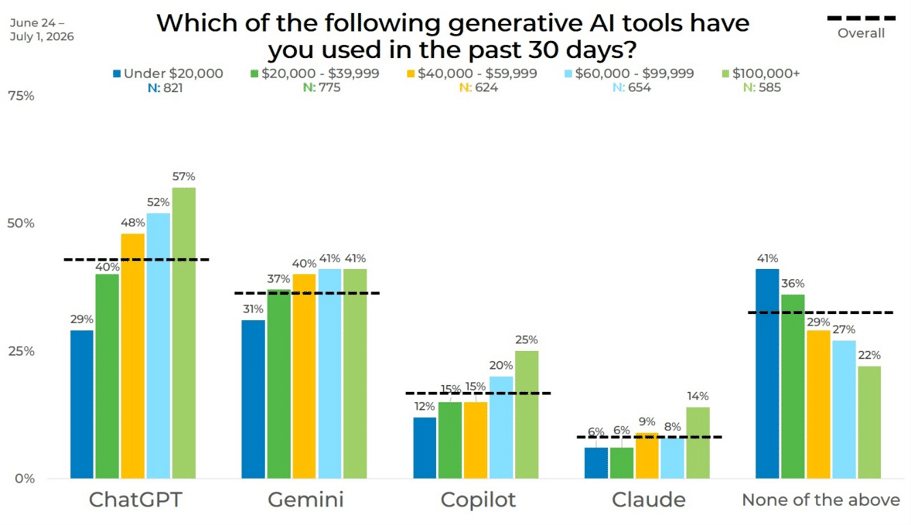
A clear pattern of generative AI usage is present when breaking down the data by income: usage increases as income increases.
This pattern is present across all tools we asked about, but the level to which usage increases differs by tool. ChatGPT has the largest increase in usage, going from 29% among respondents earning under $20,000 to 57% among those earning $100,000 or more.
Gemini also showed an upward trend across income levels, rising from 31% in the lowest-income group to 41% among respondents in both of the two highest-income categories. Copilot and Grok followed similar but more modest patterns, with Copilot increasing from 12% among the lowest-income respondents to 25% in the highest-income group, and Grok rising from 6% in the two lowest-income categories to 14% at the top.
Political Affiliation
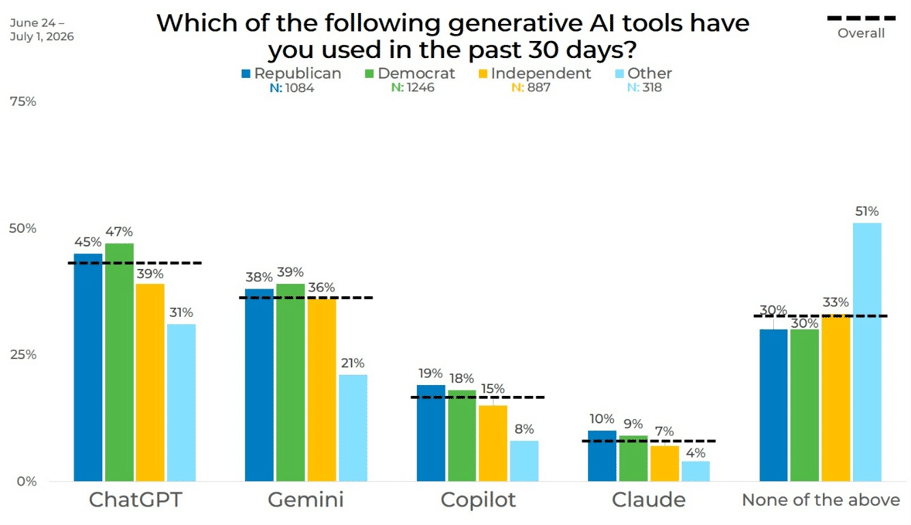
As we have observed across all US consumers and other demographic breakdowns, ChatGPT and Gemini have the highest usage across political affiliations.
Ethnicity
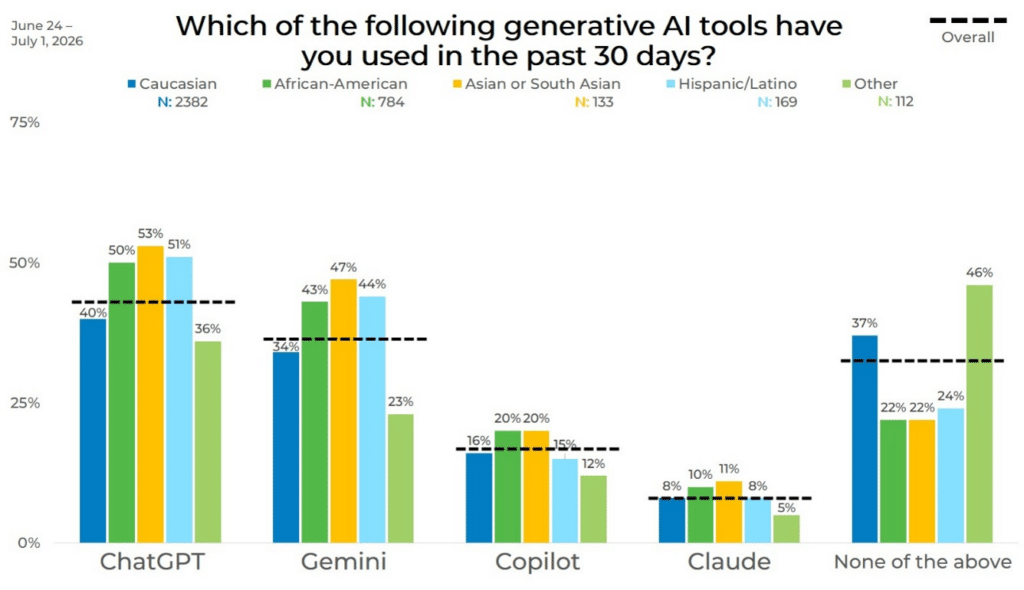
When we looked at the data by ethnicity, some usage patterns emerged. While ChatGPT had the highest usage across all ethnicities, Asians had the highest usage across all tools. Hispanics and African Americans had the second-highest usage, depending on the specific tool.
Caucasians’ usage of generative AI tools is lower across most tools, with usage 9 and 13 percentage points lower for ChatGPT and Gemini than for Asians, Hispanics, or African Americans.
Panel
Finally, when we look at the data by panel source, we see some definite AI tool usage differences. Panel T reports the highest usage of ChatGPT at 59%, 14 percentage points higher than the next panel (Panel I).
Panel I’s usage follows the same tool-usage pattern we observed among all US consumers. Panel W, on the other hand, has significantly lower usage of ChatGPT and Claude compared to other panels. They are in the top 3 panels in usage for Copilot and Gemini, though.
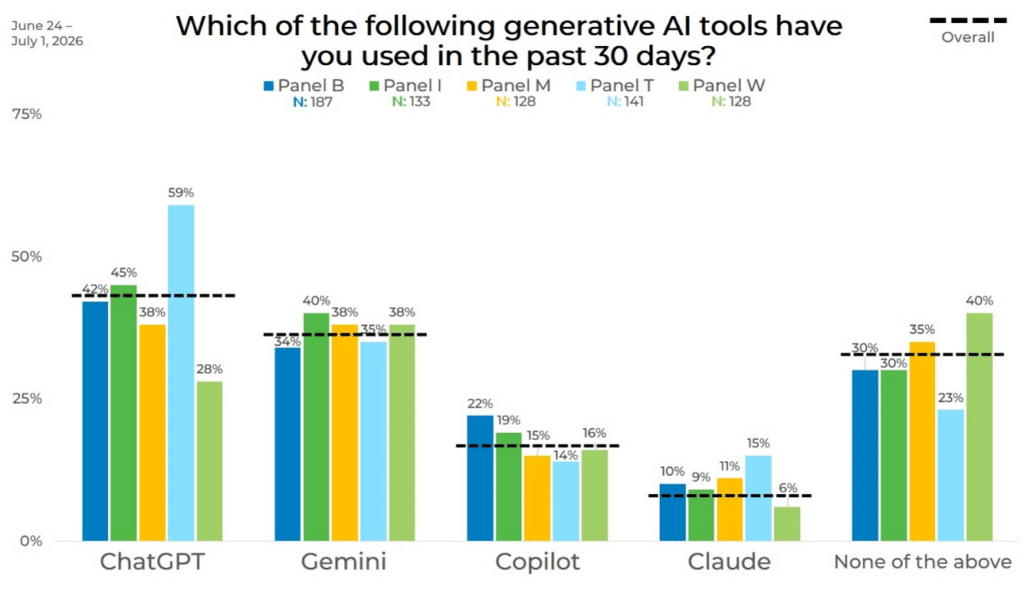
This data highlights the need to strategically blend your sample sources. If you were fielding a study around generative AI, you would get vastly different results depending on the panel mix you used.
To learn how EMI can help you with your next study, click the button below.