

A Nation Divided on the Economy: Beyond the Numbers
June 24, 2026
How AI-Generated Visuals Are Transforming Market Research Design
June 26, 2026
EMI is in the survey business. This really shouldn’t come as a surprise. Because we are in the survey business, we strive to understand the motivation of survey respondents to take surveys.
In our most recent wave of research-on-research, we sidestepped nuance and asked respondents why they liked taking surveys. Some of the insights were surprising.
Let’s dive in.
Overall
Rewards are the strongest driver of survey participation, with 86% of respondents saying they enjoy taking surveys for money, gift cards, or other incentives. Beyond rewards, many respondents are motivated by the opportunity to share their opinions and feel heard, selected by 62%, while 51% say they enjoy learning about new products, ideas, or topics.
Other motivations are less common but still meaningful. About 43% say surveys provide a way to pass the time, and 38% value the opportunity to influence companies, brands, or decisions. Early access to products, ads, or new ideas is a factor for 26% of respondents, while just 1% selected Other.
Gender
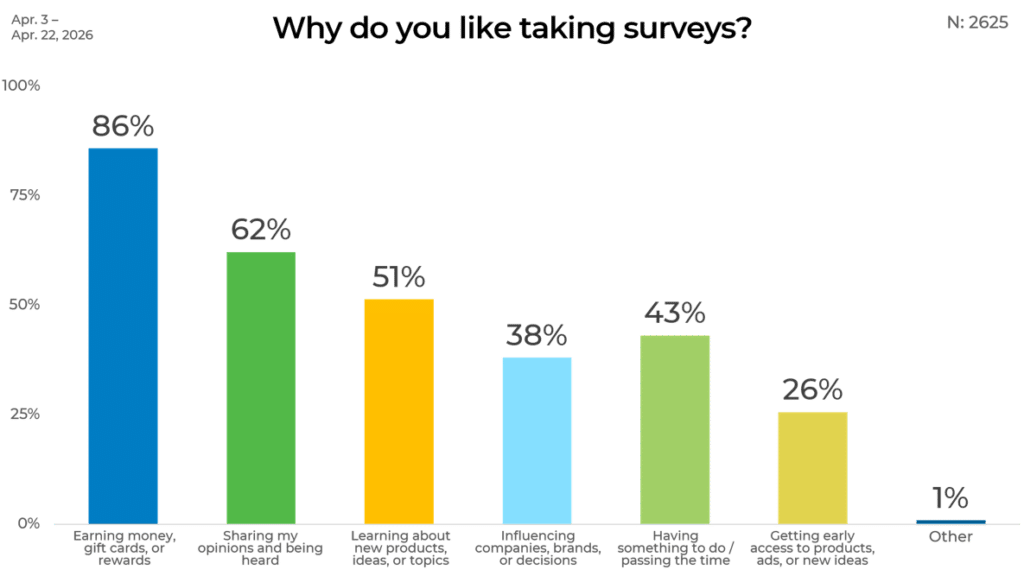
Men and women show largely similar motivations for taking surveys, with only a few notable differences. The largest gap appears in the importance of rewards, with 89% of women saying they like taking surveys to earn money, gift cards, or other incentives, compared with 82% of men.
For several motivations, responses are nearly identical across genders. Sharing opinions and being heard is selected by 62% of both men and women, while learning about new products, ideas, or topics is selected by 51% of both groups. The share who say they enjoy influencing companies, brands, or decisions is also the same, at 38%.
Smaller differences appear in less common motivations. Passing the time is selected by 44% of men and 43% of women, while early access to products, ads, or new ideas is cited by 25% of men and 26% of women. Overall, survey motivations are remarkably consistent across genders.
Age
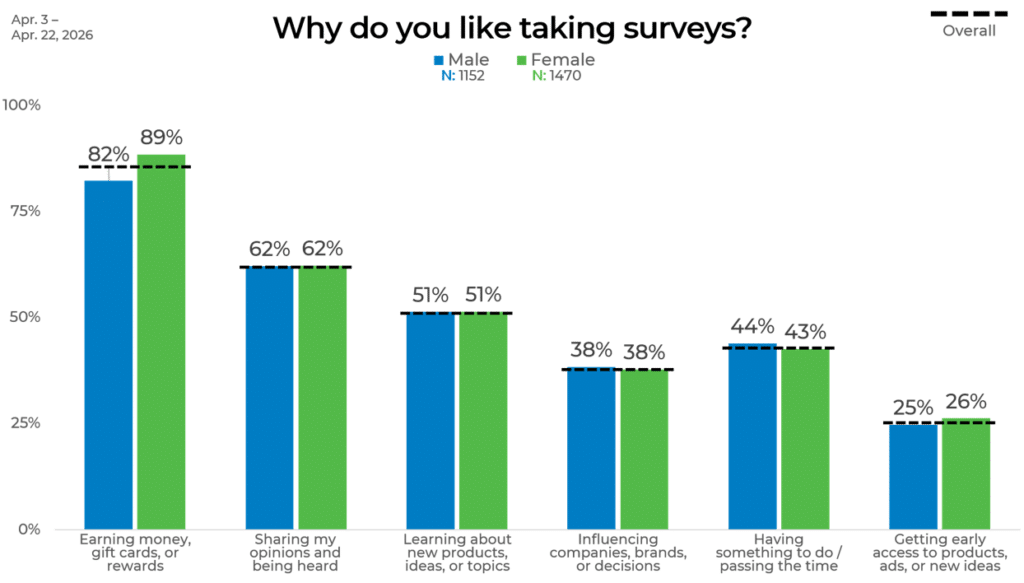
Rewards are the leading motivation across all age groups and generally increase with age. The share selecting money, gift cards, or rewards rises from 80% among adults ages 25–34 to 91% among those 65 and older. Adults ages 45–64 are also highly motivated by rewards, at 88%, while those ages 18–24 are at 83%.
The largest age difference appears in the desire to share opinions and be heard. This motivation is selected by 48% of adults ages 18–24, compared with 64% of adults ages 45–64 and 65% of those 65 and older. Younger adults are more likely than older groups to value early access to products, ads, or new ideas, with 30% of adults ages 25–34 and 28% of those ages 18–24 selecting this reason, compared with 20% of adults ages 65 and older.
Overall, older respondents are more likely to view surveys as a way to earn rewards and share their opinions, while younger respondents show somewhat more interest in early access opportunities.
Income
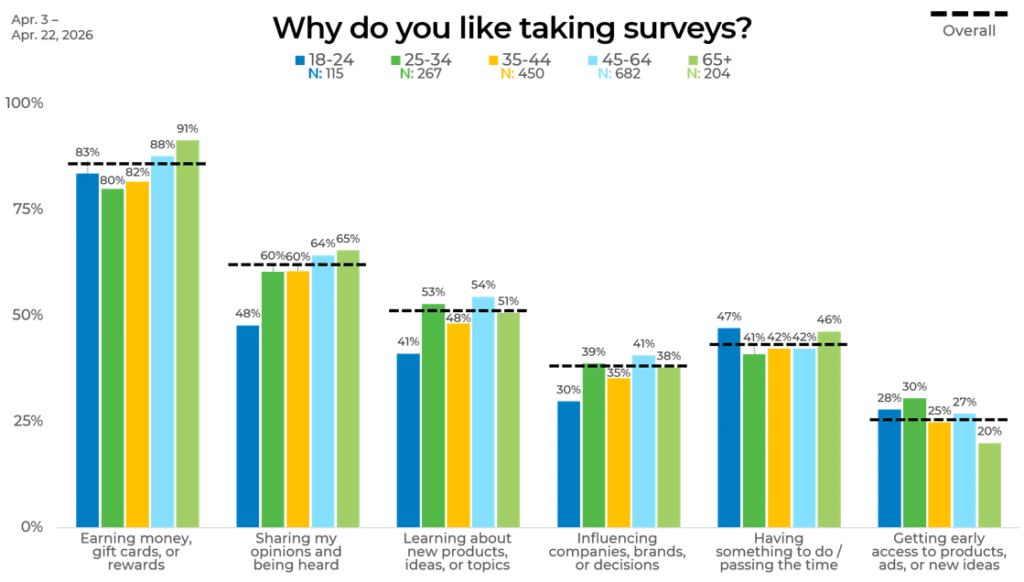
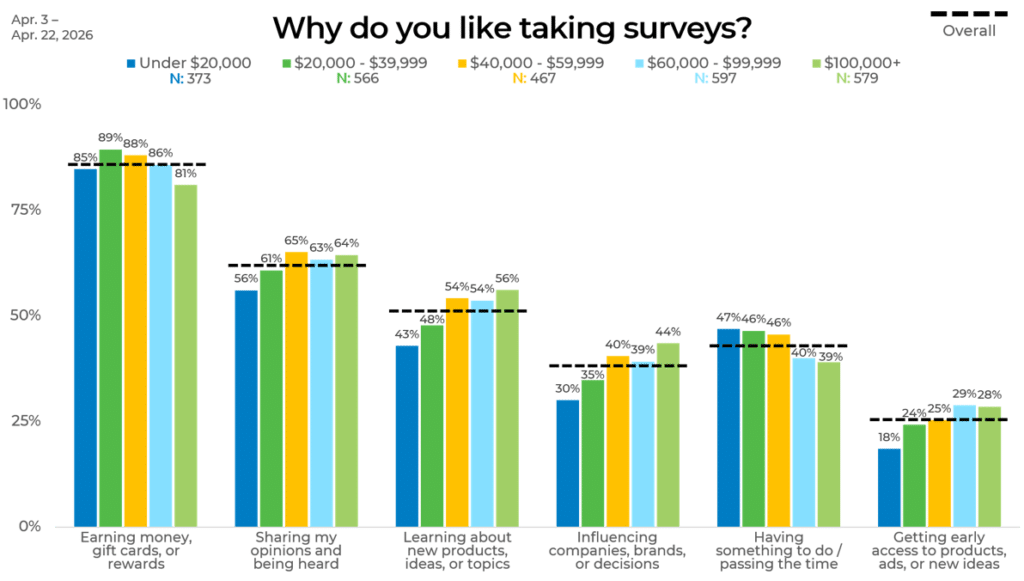
While rewards remain the most common reason for taking surveys across all income groups, the pattern varies somewhat by income level. Respondents earning $20,000–$39,999 are the most likely to cite rewards, at 89%, while those earning $100,000 or more are the least likely, at 81%.
Income differences are more apparent in motivations beyond incentives. Higher-income respondents are more likely to say they enjoy learning about new products, ideas, or topics, increasing from 43% among those earning under $20,000 to 56% among those earning $100,000 or more. The same trend appears for influencing companies, brands, or decisions, which rises from 30% in the lowest income group to 44% in the highest.
Lower-income respondents are more likely to view surveys as a way to fill time. This reason is selected by 47% of those earning under $20,000 and 46% of those earning $20,000–$39,999 and $40,000–$59,999, compared with 39% among respondents earning $100,000 or more. Overall, income appears to shape not only how often people value rewards, but also the types of engagement they seek from surveys.
Political Affiliation
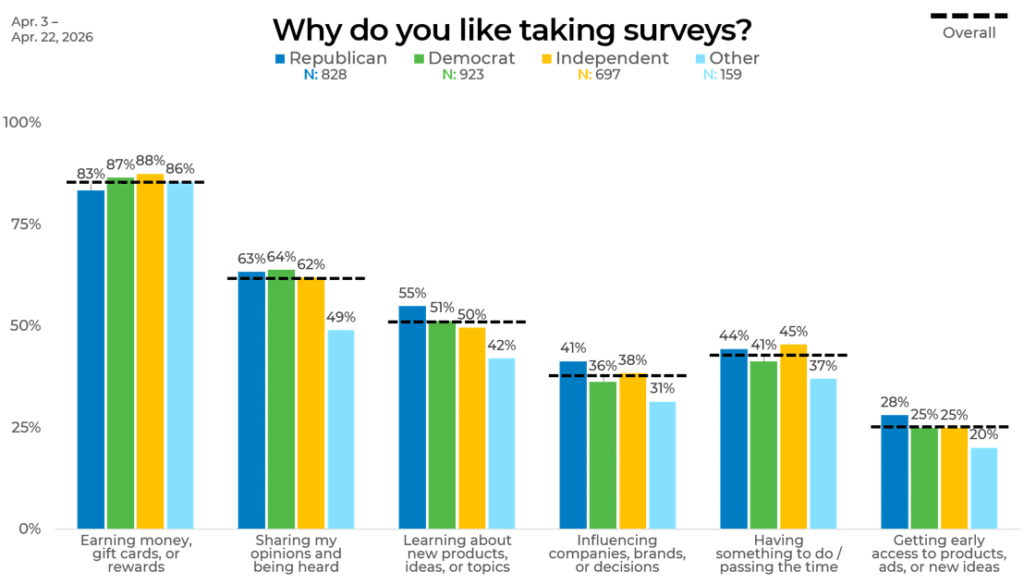
Across political groups, rewards are the leading motivation for taking surveys, with little variation between groups. Republicans report the lowest share citing money, gift cards, or rewards at 83%, while Democrats are at 87%, Independents at 88%, and Other respondents at 86%.
The largest difference appears in the desire to share opinions and be heard. Democrats rank this motivation highest at 64%, followed closely by Republicans at 63% and Independents at 62%. Respondents in the Other category are lower, at 49%.
Some smaller differences emerge in other motivations. Republicans are somewhat more likely than Democrats to say they enjoy learning about new products, ideas, or topics (55% vs. 51%) and influencing companies, brands, or decisions (41% vs. 36%). Early access to products, ads, or new ideas is less common across all groups, ranging from 20% among Other respondents to 28% among Republicans.
Region
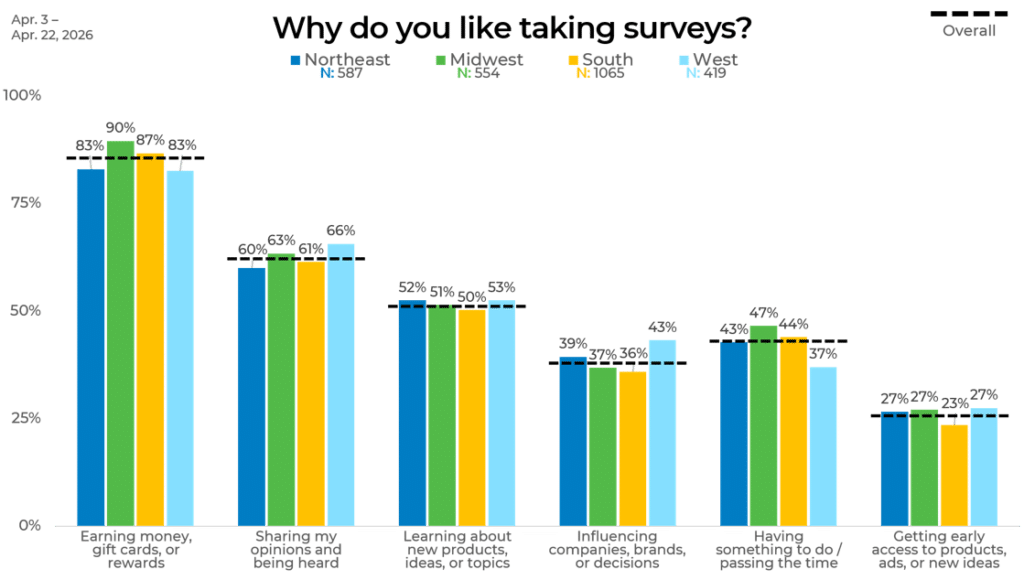
Rewards are the top motivation for taking surveys across every region, with the Midwest reporting the highest share at 90%. The South follows at 87%, while the Northeast and West are both at 83%.
Regional differences are more noticeable for secondary motivations. The West stands out for sharing opinions and being heard, with 66% selecting this reason compared with 63% in the Midwest, 61% in the South, and 60% in the Northeast. The West also leads in the desire to influence companies, brands, or decisions, at 43%.
The Midwest ranks highest for surveys as a way to pass the time, with 47% selecting this motivation compared with 37% in the West. Overall, regional differences are modest, with rewards remaining the primary driver across all areas.
Ethnicity
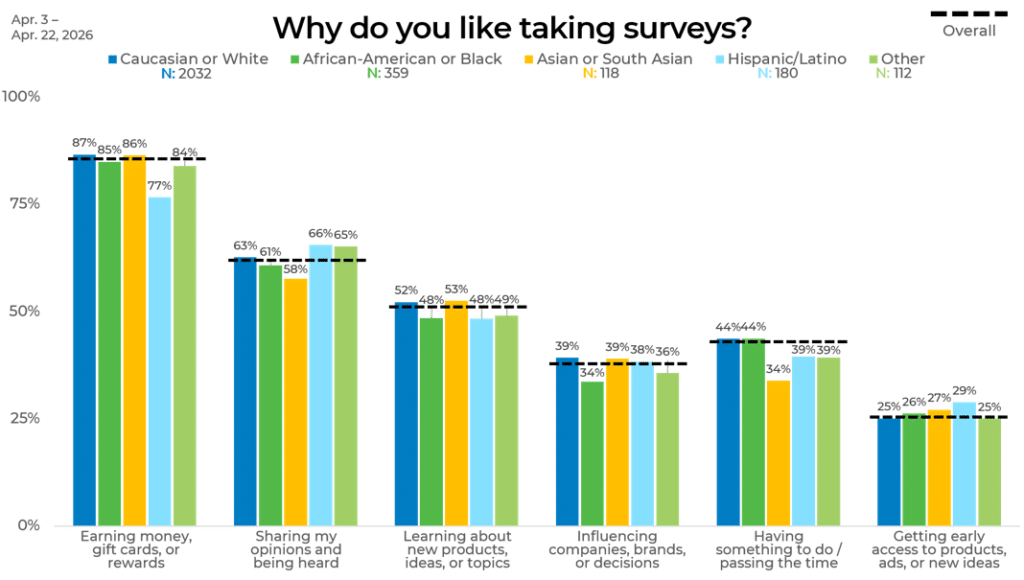
Across racial and ethnic groups, rewards remain the most common reason for taking surveys, though the strength of this motivation varies somewhat. Caucasian or White respondents rank highest at 87%, followed closely by Asian or South Asian respondents at 86%, African-American or Black respondents at 85%, and Other respondents at 84%. Hispanic/Latino respondents report the lowest share citing rewards, at 77%.
Differences become more noticeable across other motivations. Hispanic/Latino respondents are most likely to say they enjoy sharing opinions and being heard, at 66%, while Asian or South Asian respondents are lowest at 58%. Asian or South Asian respondents lead in interest in learning about new products, ideas, or topics, at 53%, with Caucasian or White respondents close behind at 52%.
The largest gap appears in using surveys as a way to pass the time. This motivation is selected by 44% of both Caucasian or White and African-American or Black respondents, compared with 34% of Asian or South Asian respondents. Overall, rewards remain the primary driver across groups, while secondary motivations show more variation.
Panel
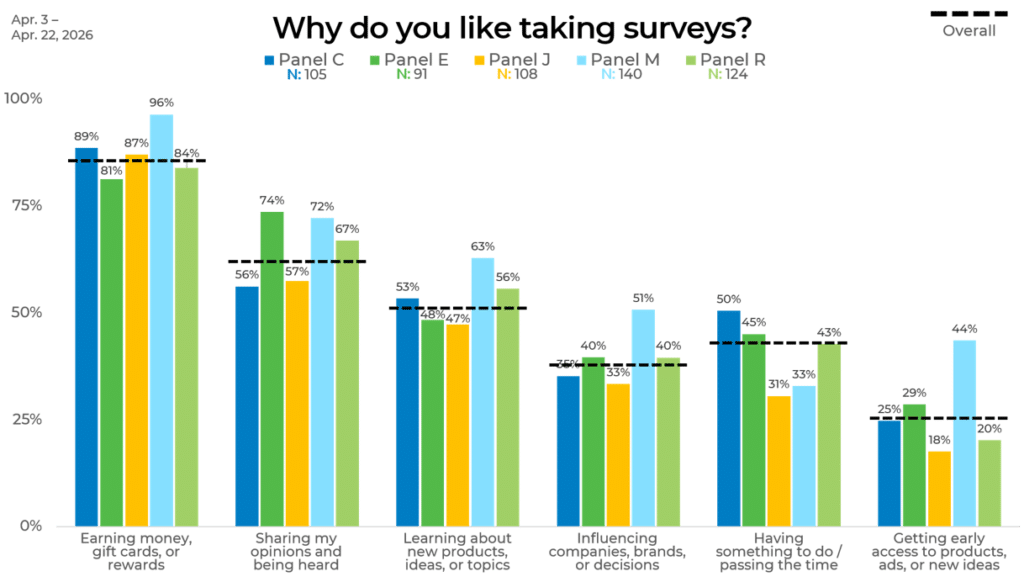
Panel results show some of the strongest variation across the survey, with noticeable differences in several motivations for taking surveys. The largest gap appears in earning money, gift cards, or rewards, ranging from 81% in Panel E to 96% in Panel M, a 15-point difference. Early access to products, ads, or new ideas shows an even wider spread, ranging from 18% in Panel J to 44% in Panel M, a 26-point gap. Panel M also leads in influencing companies, brands, or decisions, at 51%, compared with 33% in Panel J.
Other motivations show smaller but still meaningful differences. Sharing opinions and being heard ranges from 56% in Panel C to 74% in Panel E, while learning about new products, ideas, or topics ranges from 47% in Panel J to 63% in Panel M. The share who cite having something to do or passing the time ranges from 31% in Panel J to 50% in Panel C.
Overall, Panel M consistently reports higher engagement across several motivations, particularly those tied to rewards, learning, and influence. Panel J tends to show lower levels across multiple measures, suggesting different engagement patterns between these respondent sources.
Survey participation is shaped by more than rewards alone. While incentives remain the leading driver, respondents are also motivated by the opportunity to share their perspectives, learn about new ideas, and influence decisions.
Across demographic groups, the core reasons for participation remain consistent, with meaningful differences emerging among age, income, and respondent audiences. As survey engagement continues to evolve, understanding these motivations can help organizations create stronger connections and capture more valuable insights.
Connect with EMI to explore these findings in more depth and discuss what they mean for your research strategy.