

The Top Trends Impacting MRX with Matt Valle of the Rock n’ Roll Research Podcast
July 23, 2026
Survey Fraud Is Evolving: Is Your Data Quality Strategy Keeping Up?
July 30, 2026
As economic conditions continue to evolve, we continued to track US consumers and their opinions on their financial future. In our recent wave of research-on-research, we asked US consumer if they thought their financial state would improve to worse in the next six months.
Let’s dive into what people are expecting.
Overall
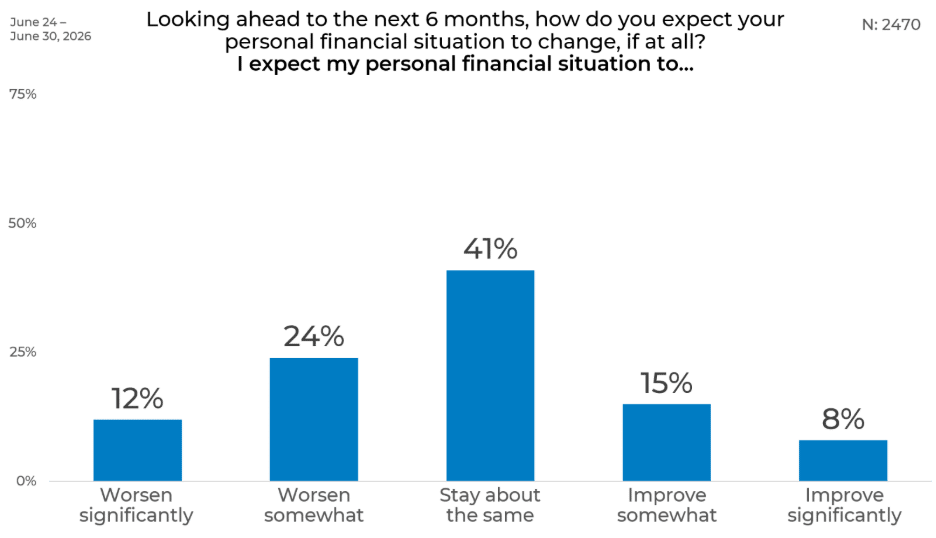
When looking ahead to the next six months, respondents were more likely to expect stability or improvement in their personal finances than a decline. Overall, 42% said their financial situation would stay about the same. Another 39% anticipated improvement, including 27% who expected it to improve somewhat and 12% who expected it to improve significantly.
By comparison, 18% expected their financial situation to worsen. This included 12% who anticipated it would worsen somewhat and 6% who believed it would worsen significantly.
Gender
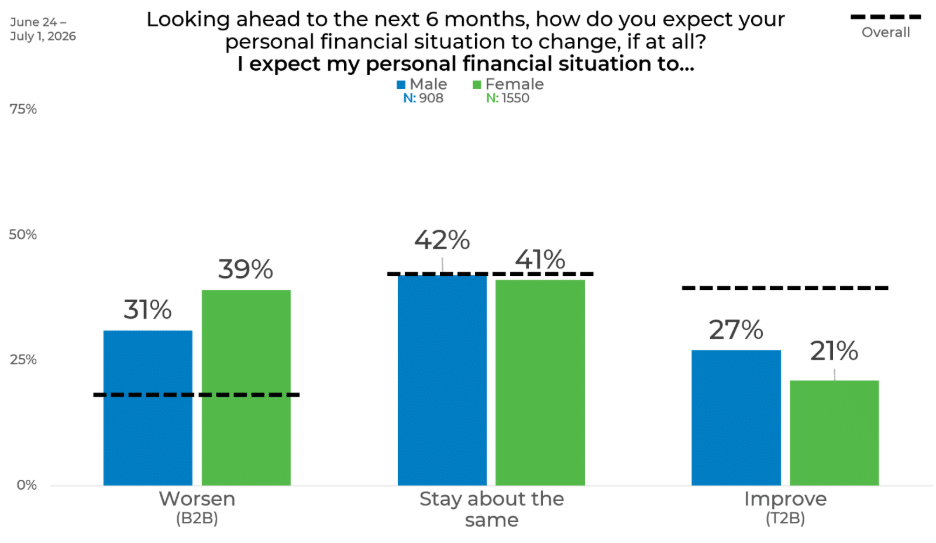
Men expressed somewhat greater financial optimism than women. Among male respondents, 44% expected their personal financial situation to improve, compared with 37% of female respondents.
Women were more likely to expect little change, with 45% saying their situation would stay about the same, versus 38% of men. Expectations of worsening finances were similar between the two groups, at 17% among men and 19% among women.
Age
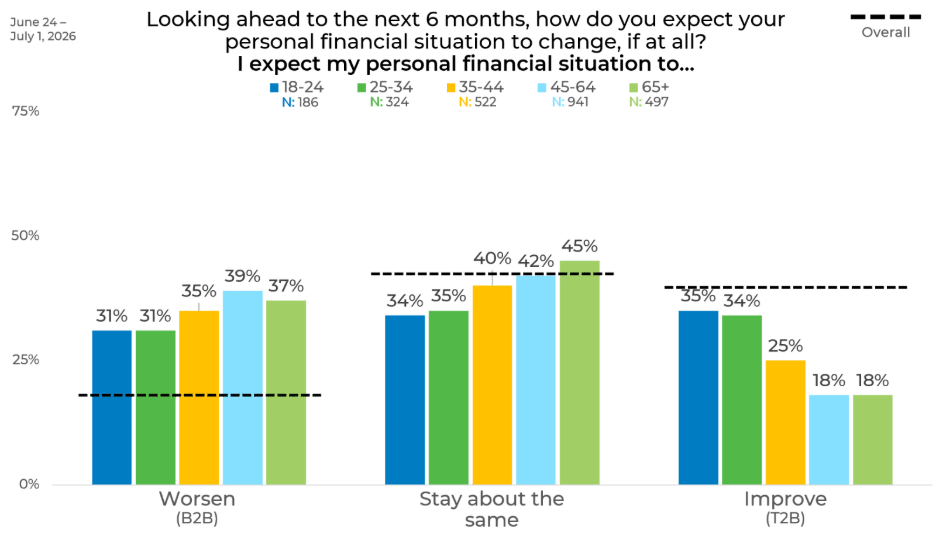
Age produced one of the clearest differences in the results. Expectations of improvement declined steadily across older age groups, falling from 67% among respondents ages 18 to 24 to 60% among those ages 25 to 34, 47% among those ages 35 to 44, 34% among those ages 45 to 64, and 19% among respondents age 65 or older.
The pattern was reversed for expectations of stability. Just 23% of respondents ages 18 to 24 expected their finances to stay about the same, compared with 56% of those age 65 or older. The share anticipating worsening finances also rose with age, from 11% in both groups under age 35 to 25% among those age 65 or older.
Income
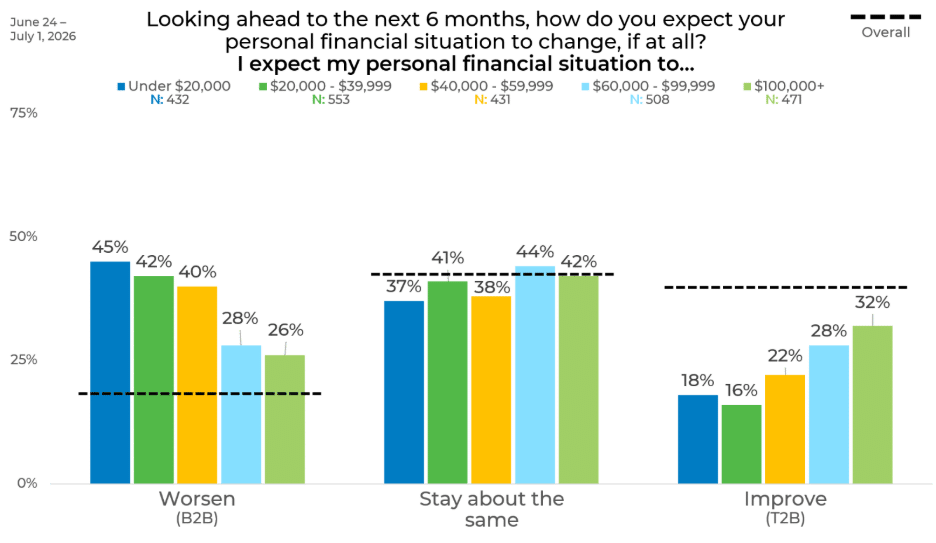
Financial expectations were comparatively consistent across income groups. The share expecting improvement ranged from 37% among respondents earning $100,000 or more to 42% among those earning between $20,000 and $39,999.
Respondents earning $100,000 or more were the most likely to expect their situation to stay about the same, at 48%, compared with 44% of those earning $60,000 to $99,999, 42% of those earning $40,000 to $59,999, 39% of those earning $20,000 to $39,999, and 37% of those earning under $20,000. Those earning under $20,000 were the most likely to expect their finances to worsen, at 23%, while the two highest-income groups recorded the lowest shares, both at 15%.
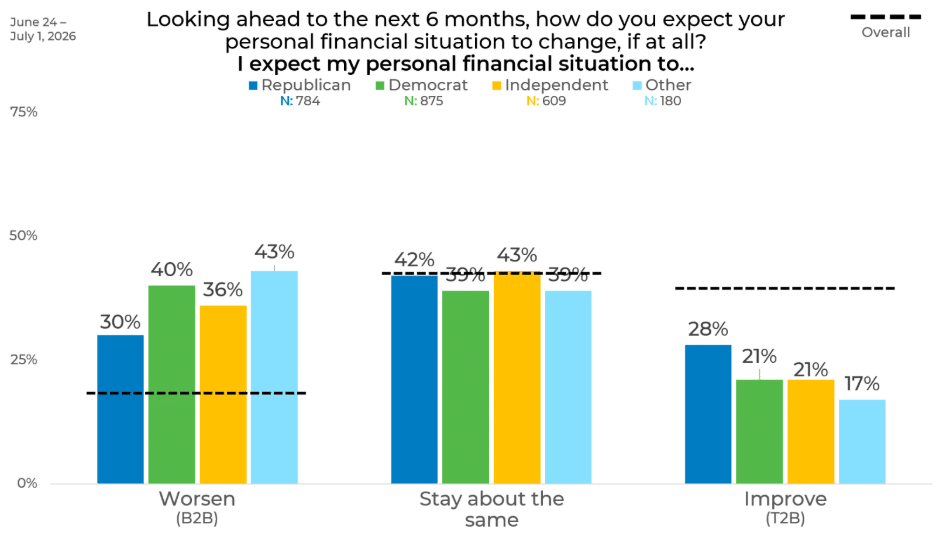
Political Affiliation
Expectations varied moderately by political affiliation. Respondents identifying with another political affiliation were the most likely to expect improvement, at 47%, followed by Republicans at 44%. Improvement was anticipated by 37% of Democrats and 35% of Independents.
Democrats and Independents were the most likely to expect their financial situation to worsen, both at 21%, compared with 17% among those in the Other category and 13% among Republicans. Expectations of stability were relatively close among Republicans, Democrats, and Independents, ranging from 42% to 44%, while 37% of respondents in the Other group expected their finances to remain about the same.
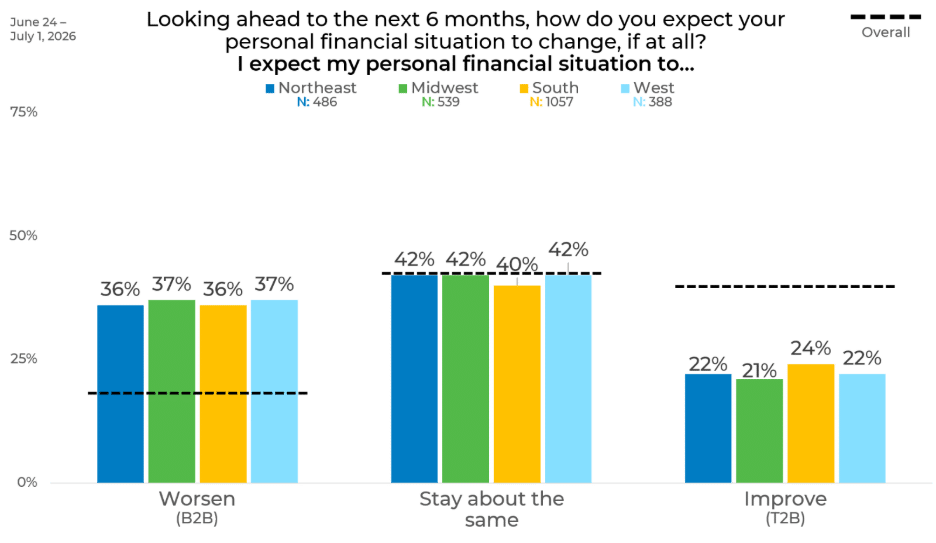
Region
Respondents in the West and South were more optimistic about their financial outlook than those in the Midwest and Northeast. Improvement was expected by 43% of Western respondents and 42% of those in the South, compared with 36% in the Midwest and 35% in the Northeast.
The Northeast had the largest share expecting no change, at 46%, followed closely by the Midwest at 45%. Stability was less commonly expected in the South, at 40%, and the West, at 39%. Expectations of worsening finances ranged narrowly from 17% in both the South and West to 20% in the Midwest.
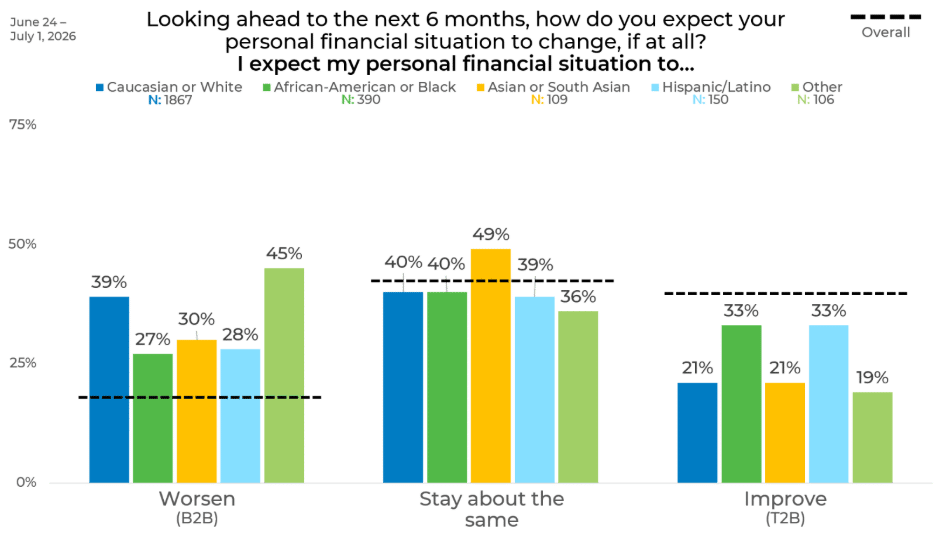
Ethnicity
Financial expectations differed substantially across racial and ethnic groups. African-American or Black respondents were the most likely to expect improvement, at 66%, followed by Hispanic or Latino respondents at 53%. Improvement was expected by 45% of respondents in the Other category, 43% of Asian or South Asian respondents, and 33% of Caucasian or White respondents.
Caucasian or White respondents were the most likely to expect their financial situation to remain about the same, at 47%, compared with 41% of Asian or South Asian respondents, 34% of Hispanic or Latino respondents, 31% of those in the Other category, and 26% of African-American or Black respondents. Expectations of worsening finances were lowest among African-American or Black respondents, at 8%, and highest among respondents in the Other category, at 24%, followed by Caucasian or White respondents at 20%.
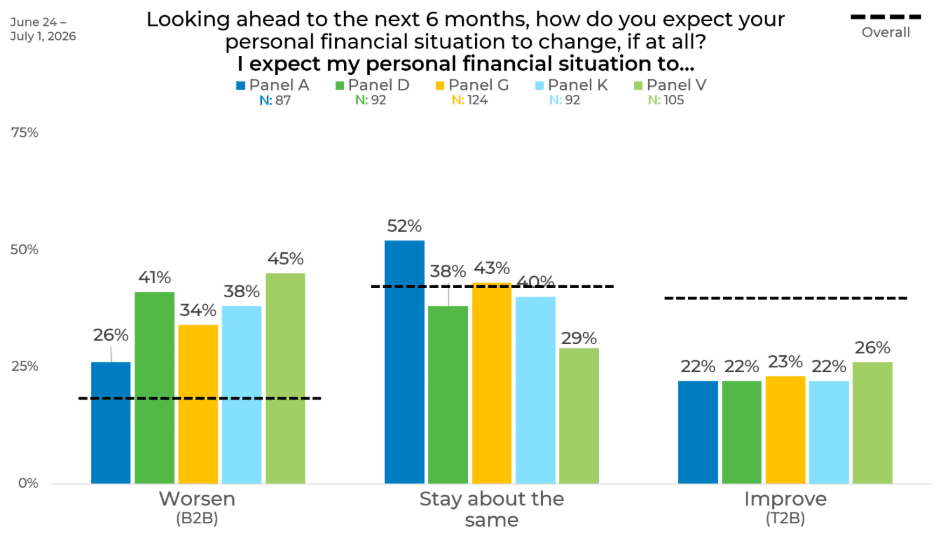
Panel
Combining results from multiple panels provides a broader view of how expectations differ across respondent sources. The largest difference appeared between Panel N, where 49% expected improvement, and Panel K, where 19% did so, creating a 30-point gap. Panel K instead had the highest expectation of stability, at 58%, compared with 37% in Panel R, the lowest level among the panels.
Expectations of worsening finances were highest in Panel F at 26%, followed by Panel R at 24% and Panel K at 23%. Panel N recorded the lowest share expecting a decline, at 10%. Panel C fell closer to the middle of the range, with 41% expecting improvement, 44% expecting stability, and 15% expecting their finances to worsen.
Wrap up
While most respondents expect their personal finances to remain stable or improve over the next six months, financial expectations vary noticeably across demographic groups. Age, race and ethnicity, income, and region all influence how optimistic Americans feel about their financial future, offering a more nuanced view of consumer sentiment.
As economic conditions continue to evolve, understanding these differences is essential for interpreting shifts in financial confidence. Explore the full findings to see how expectations differ across demographic groups and uncover the trends shaping Americans’ financial outlook.