

CRC Recap: AI, Fraud, Budget Cuts, and One Very Expensive Uber
September 22, 2026
To Scroll or Not To Scroll, That is the Question
September 28, 2026
Prediction markets have gone from a niche corner of the internet to one of the fastest-growing areas in finance and entertainment. Billions are being traded on everything from elections, military strikes, and interest rates to sports and pop culture, while platforms like Kalshi have seen their valuations and trading volumes skyrocket. You would think that kind of growth would make prediction markets a household name. The latest data from our research-on-research would suggest otherwise. We asked consumers how trustworthy they consider prediction markets like Kalshi to be. Before we could even get to trust, we uncovered something much more fundamental: many people still have no idea what they are.
Overall
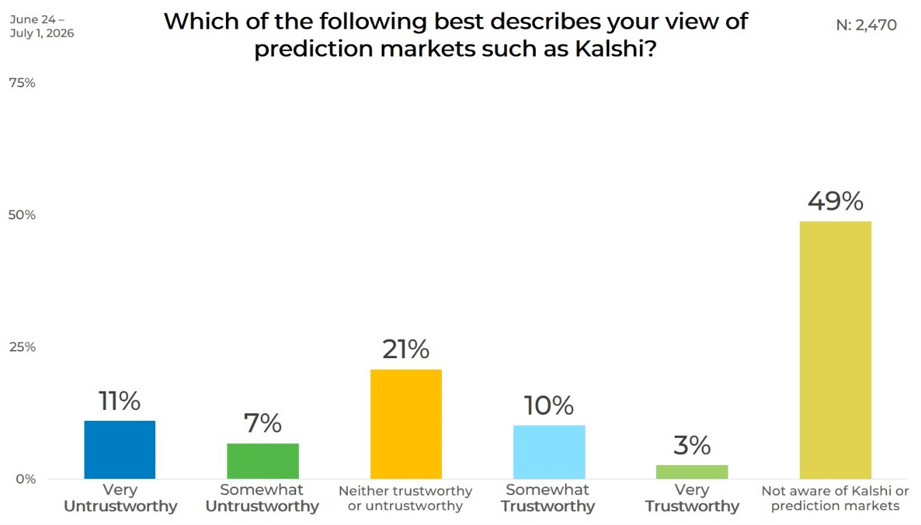
Nearly half of respondents (49%) say they are not aware of Kalshi or prediction markets. Among the remaining responses, neutrality is the most common position, with 21% describing prediction markets as neither trustworthy nor untrustworthy.
Negative views are more prevalent than positive ones overall. 11% consider prediction markets very untrustworthy, and another 7% somewhat untrustworthy, compared with 10% who consider them somewhat trustworthy and 3% who say they are very trustworthy.
Gender
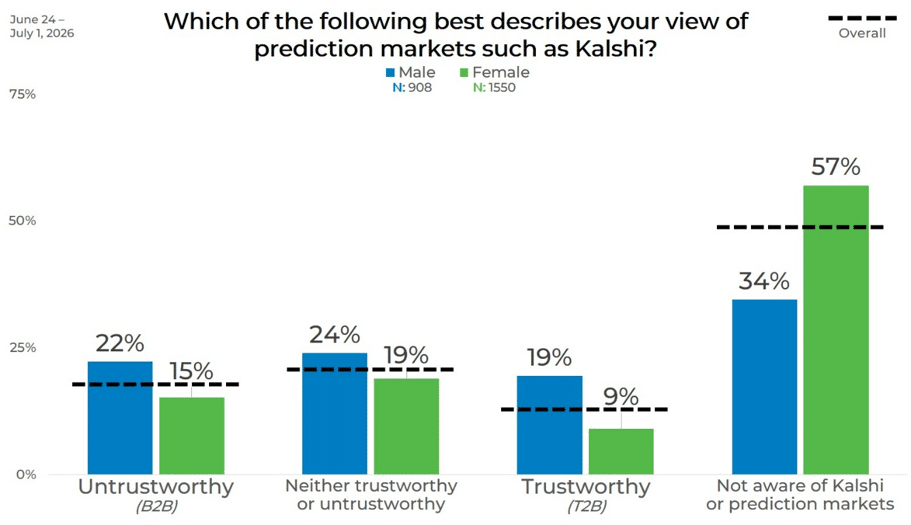
When we look at the data by gender, we see a considerable difference in awareness. More than half of women (57%) say they are not aware of Kalshi or prediction markets, compared with 34% of men. Among those aware of prediction markets, men are also more likely to express opinions at both ends of the trust spectrum. 19% of men find prediction markets trustworthy, compared to just 9% of women. At the same time, 22% of men describe prediction markets as untrustworthy, compared with 15% of women.
Age
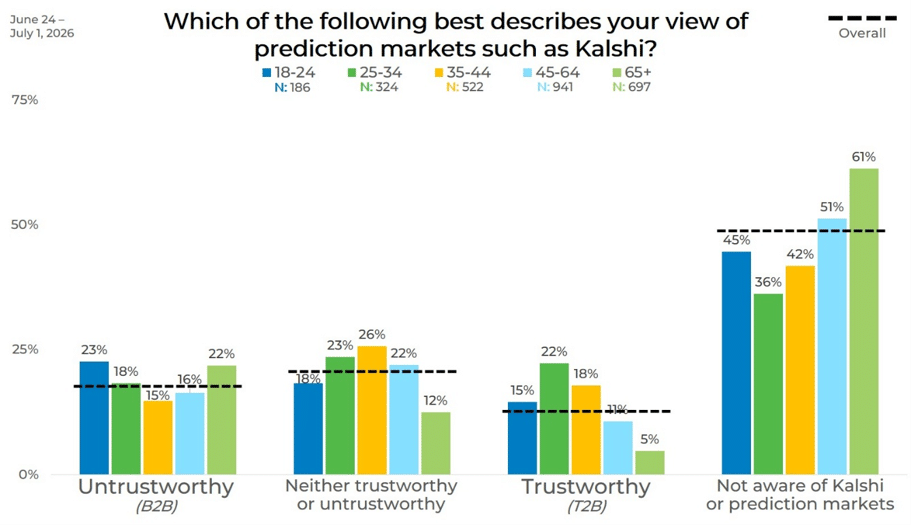
Segmenting the data by age produces some of the clearest differences in awareness of prediction markets. Among respondents ages 25-34, 36% say they are not aware of Kalshi or prediction markets, the lowest figure of any age group. The lack of awareness rises to 42% among ages 35-44 and to a high of 61% among those 65 and older. Of those who are aware of prediction markets, trust is highest among 25-34-year-olds at 22%, followed by those ages 35-44 at 18% and 18-24 at 15%. Younger respondents (18-24 year-old) have the highest percentage who find prediction markets untrustworthy, at 23%.
Income
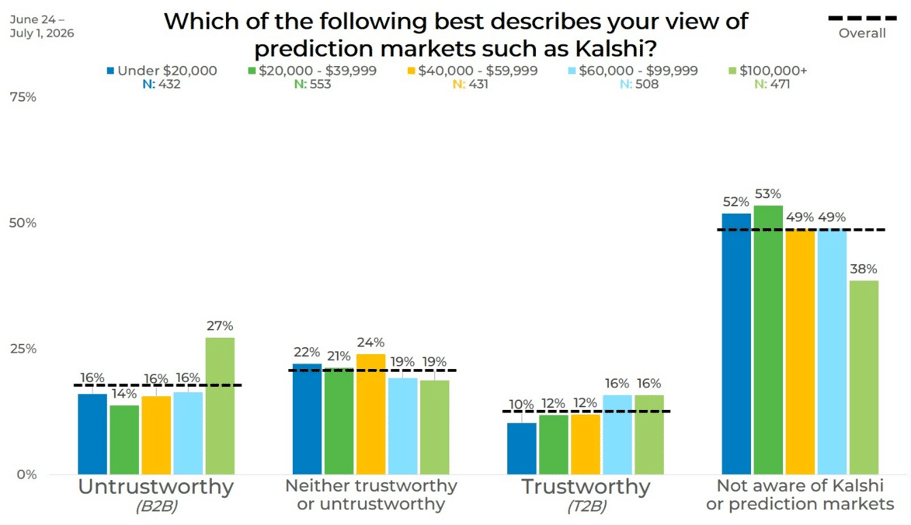
When we look at the data by income level, an interesting story emerges. Among respondents who are aware of prediction markets, those who find them untrustworthy are fairly steady across income levels, except for those who earn $100,000+, where this share is 11 points higher than in other groups.
The percentage of respondents who view prediction markets as trustworthy is fairly stable among those with an income around 12% but jumps to 16% for those with an income over $60,000.
More than half of respondents across all income levels, except those earning $100,000 or more, are unaware of prediction markets. Only 36% of respondents earning $100,000 or more are unaware.
Political Affiliation
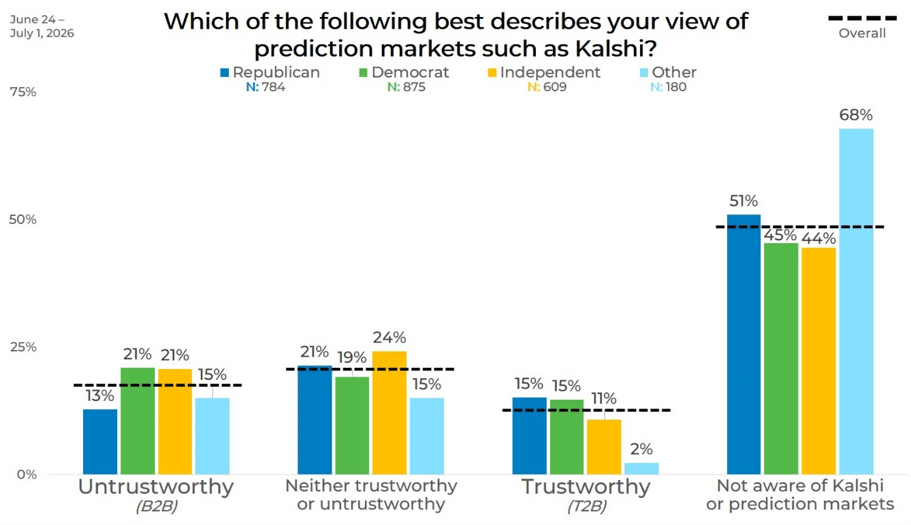
The number of respondents across all political affiliations who are unaware of prediction markets is more than double the number who view it as either trustworthy or untrustworthy.
Republicans and Democrats report the same level of trustworthiness at 15%, while those who find them untrustworthy reach 21% among both Democrats and Independents, compared with 13% among Republicans.
Ethnicity
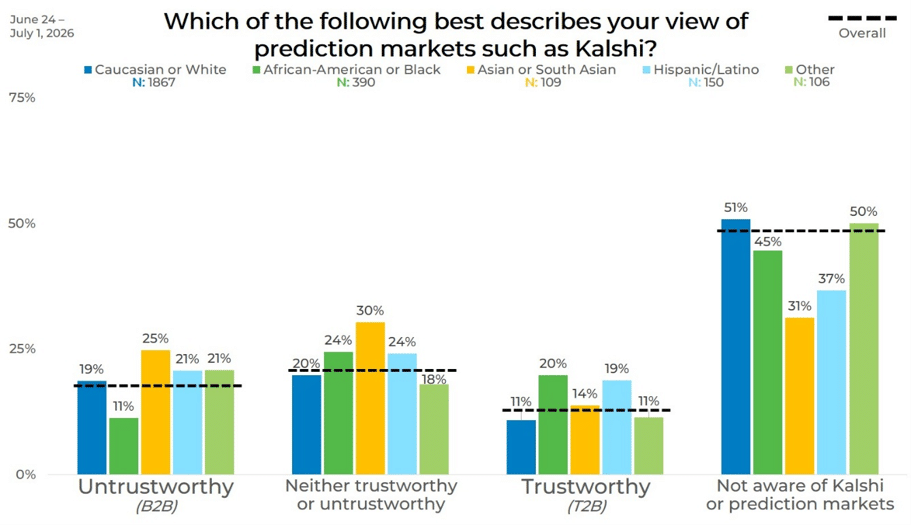
Awareness of prediction markets varies substantially across ethnicities. Half of Caucasian respondents are unaware of prediction markets, while 45% of African Americans are unaware. Only a third or less of Asian and Hispanic respondents are unaware of prediction markets. With those who are aware, the balance of trust and distrust also differs. About a fifth of African American and Hispanic respondents believe prediction markets to be trustworthy, but a quarter of Asian respondents find them untrustworthy.
Panel
Looking at awareness of prediction markets after segmenting the data by panel source shows wide variation in the proportion of respondents who are unaware of prediction markets. There is a 23-point gap between the panel with the highest level of unawareness (Panel E) and the one with the lowest (Panel U). Panel U also has the highest number of respondents who trust prediction markets, with 26%. Panels J and D have the highest levels of untrustworthiness, with 24% and 22% respectively. This is also 11 to 13 points higher than Panel U.
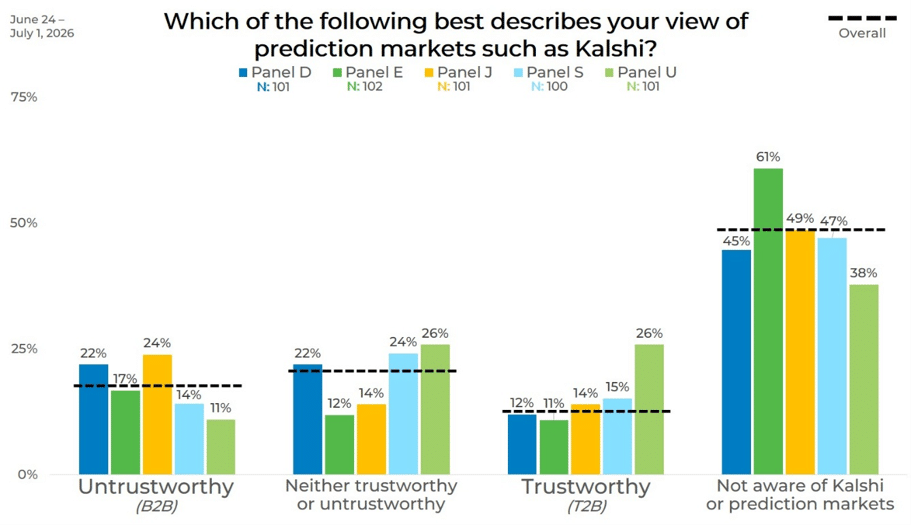
These results highlight the need to blend your sample to reduce panel bias strategically. To learn more about strategic sample blending, click the button below.