

Are We Excited About AI or Terrified of It? Yes.
September 2, 2026
AI Is Now the First Search Result. Consumers Seem Fine With It.
September 11, 2026
“This job market is the worst since COVID.”
This is a comment posted online by someone who has been job hunting for awhile now. It may be an overreaction, but there is probably more truth in the statement than not.
According to CNN, the current job market is described as a “low-hire, low-fire” environment. The unemployment rate is low, but hiring has stalled. This makes finding a new job tough due to high competition for limited roles.
In our recent round of research-on-research, we asked US consumers how they would describe the current state of the US job market.
Let’s dive in.
Overall
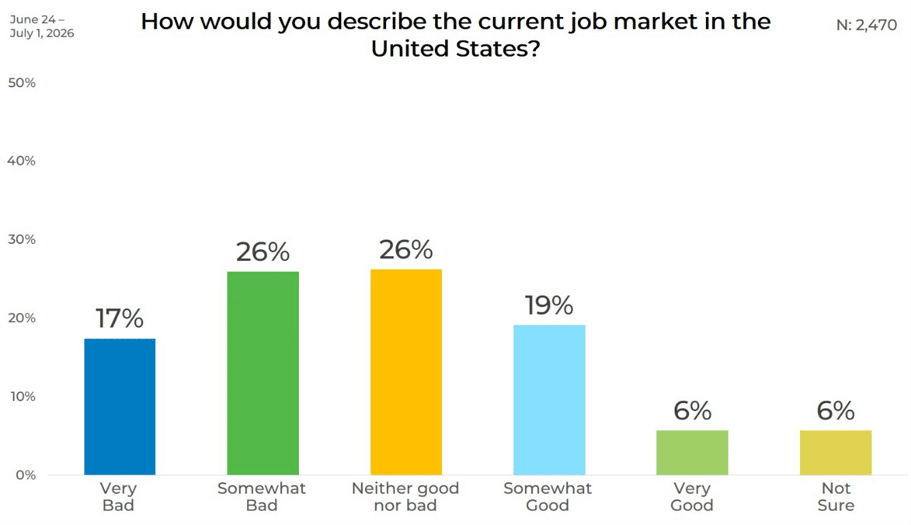
A majority of US consumers believe the current job market is bad, with 17% of that majority stating it is very bad. Only 25% of consumers say the current job market is good.
Gender
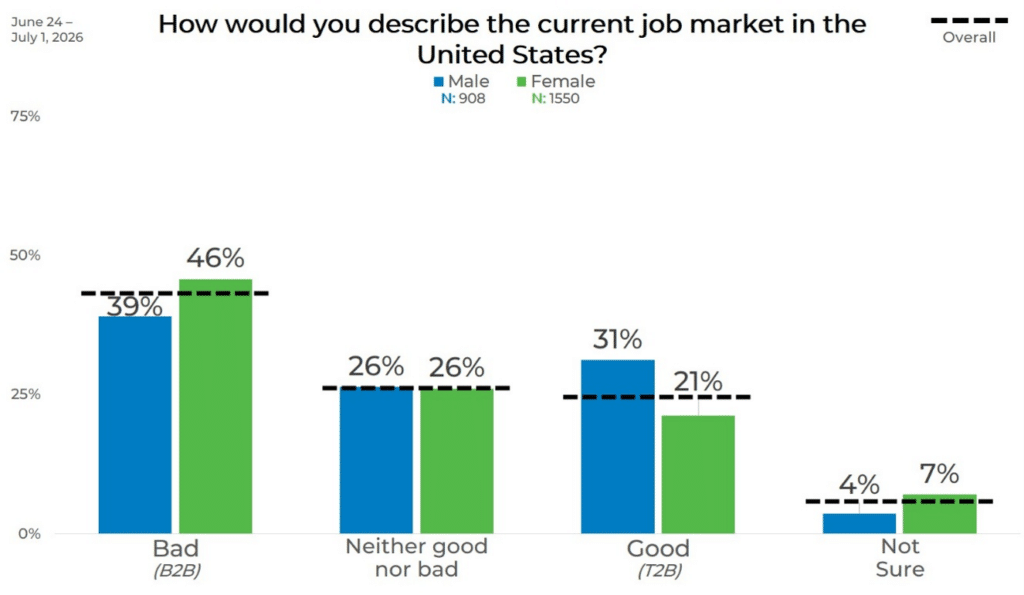
Segmenting the data by gender shows that more females have a negative view of the current job market than male, by a margin of seven percentage points. On the flip side, 10% more of males than females view the current job market at good.
Looking at the highs of both the good and bad views of the current job market, the gap of females who view the job market as bad is 15 points higher than males who view it as good.
Age
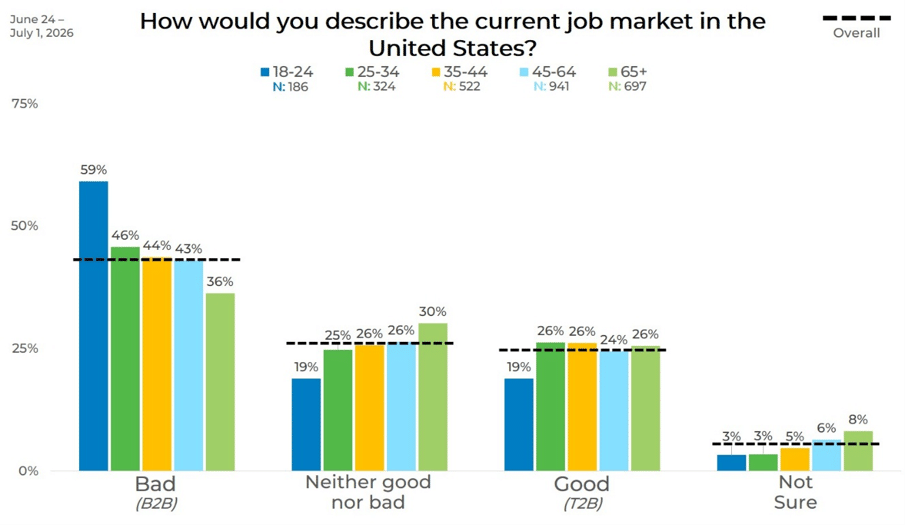
The age-segmented data uncovered that negative opinions of the current job market increase as age declines, with 59% of 18–24-year-olds viewing the current market as bad. That is 23 points higher than those aged 65+.
On the flip side, nearly 26% of all age groups, except 18-24, view the current market as good. This is 7 points higher than 18–24-year-olds.
Income
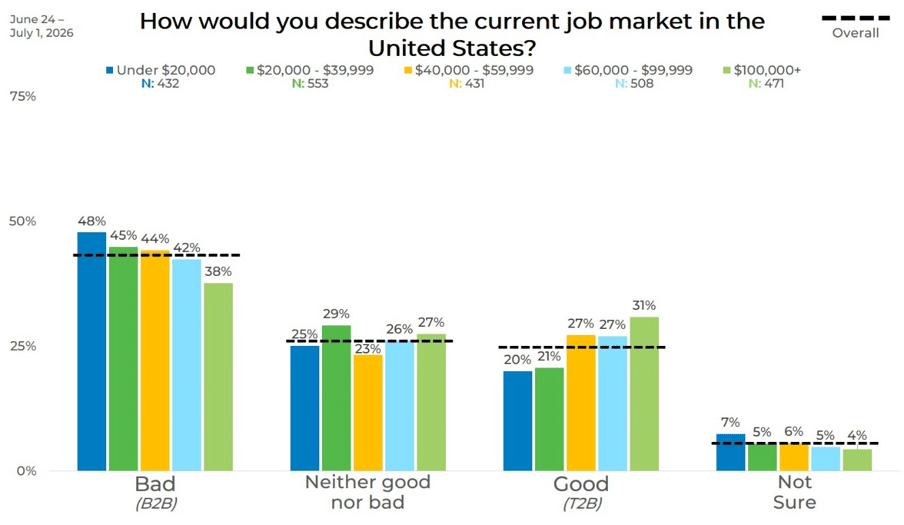
Consumers’ current assessment of the job market is linked to their income level. We see that as negative views of the current job market decline as income increases, with a 10-point gap between those with an income of $20,000 or less and those making $100,000+.
It is the opposite for positive views of the job market. 31% of respondents with an income of $100,000 or more view the current job market as good, 11-points higher than those making $20,000 or less.
Political Affiliation
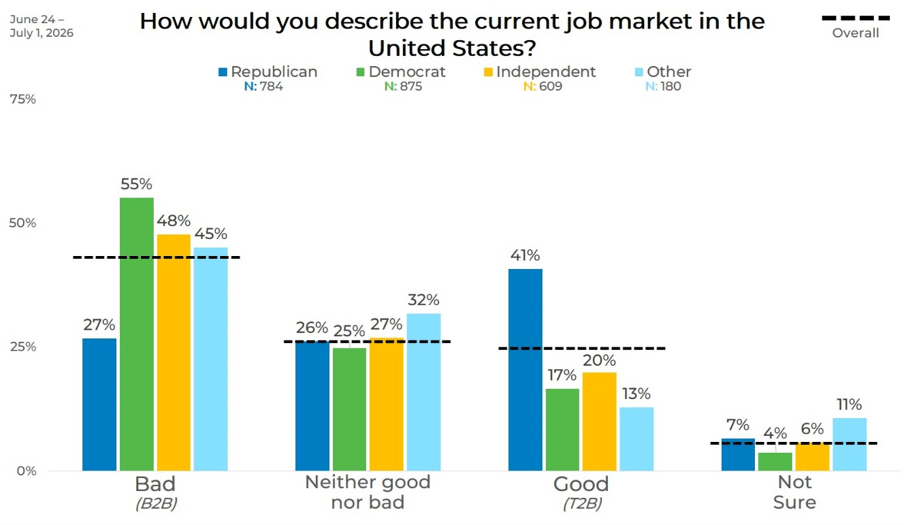
A respondent’s political affiliation heavily influences their current view of the job market. 41% of Republicans view the current job market as good, 24 points higher than Democrats.
On the other side, 55% of Democrats and 48% of Independents view the job market as bad, 28 points and 21 points higher than Republicans, respectively.
Ethnicity
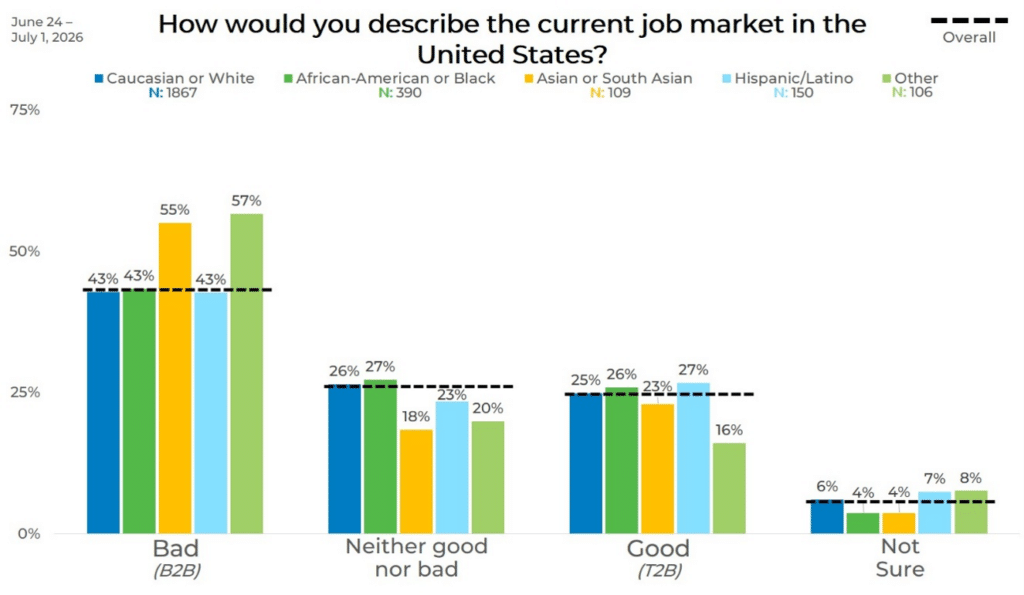
Across all ethnicities, the percent of respondents who view the current job market as bad is nearly double that of those who view it as good. African Americans stand out, as 55% have a negative view of the job market, which is 12 points higher than other ethnicities.
Panel
Some of the largest differences in views of the current job market are present when the data is segmented by panel provider. 55% of Panel V respondent view the current job market as bad, 24 points higher than Panel U, and 10 points higher than the next highest, Panel F.
Panel U has the highest number of respondents who view the current job market as good, with 34%, which is 18 points higher than Panel V, and 7 points higher than Panel D, which has the second highest number of respondents with that view.
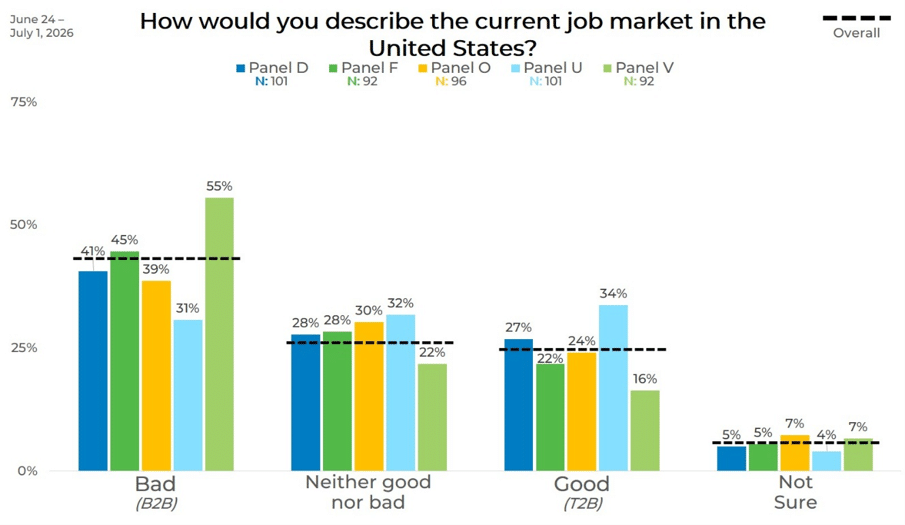
This data reinforces the need to strategically blend your sample, otherwise your data could be biased. To better understand what Strategic Sample Blending is, and how it can be incorporated into your next study, click the button below.