

The Gap is Narrowing on ChatGPT: Consumer Familiarity of the Generative AI Market
June 15, 2026
From Writing to Brainstorming: Is the Way People Are Actually Using AI Changing?
June 19, 2026
Generative AI tools have become a major part of the digital landscape, but the adoption and use of it is uneven across each platform. We have been tracking consumer’s usage of generative AI for over a year now, and with our recent wave of research-on-research just completed, we have updated statistics.
Let’s see what we uncovered.
Overall
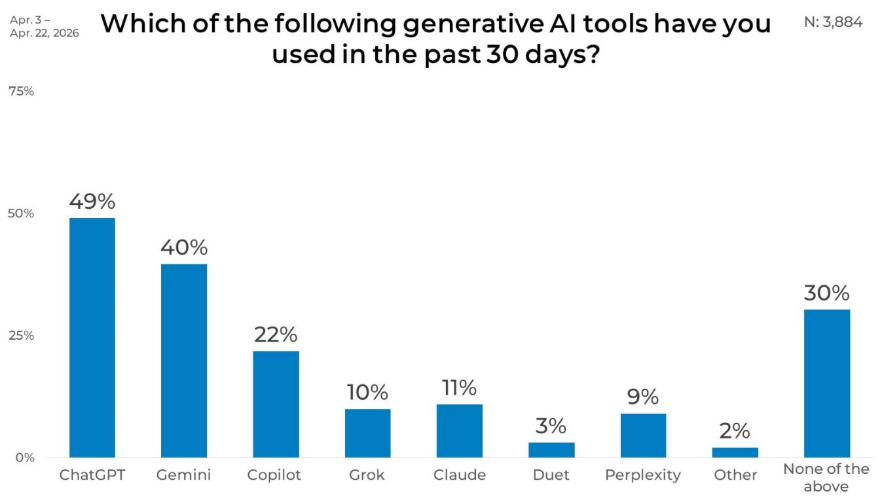
ChatGPT remains the most widely used generative AI platform, with 49% of consumers reporting that they had used it in the past 30 days. Gemini followed at 40%, making it the second most commonly used tool. After these two platforms, usage drops considerably, with Copilot used by 22% of respondents and all other platforms reaching 11% or less.
Despite the growing visibility of generative AI, adoption is not yet universal. Thirty percent of respondents reported that they had not used any generative AI tools during the same period. In fact, non-use was more common than the use of any individual platform other than ChatGPT and Gemini.
Wave over Wave
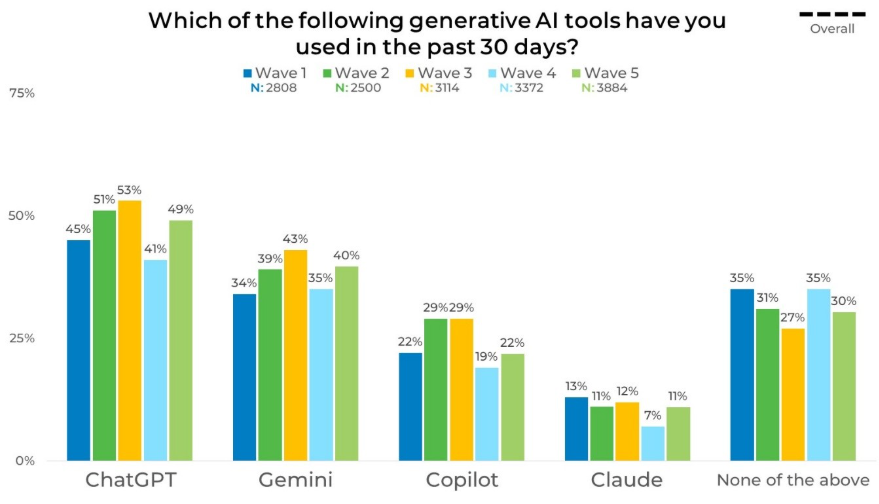
Across five waves of our research-on-research, ChatGPT consistently held its position as the most widely used generative AI tool, though it fluctuated throughout time. Both ChatGPT and Gemini reached their highest levels in wave 3 representing 53% and 43%, respectively before dropping in wave fourth and rebounding somewhat in wave 5. This suggests that generative AI adoption gained momentum early on, hit a high point in the middle of the study, and then settled into a more stable pattern as research went on.
Other tools followed a similar path. Copilot peaked at 29% in waves 2 and 3 before falling back, and Claude remained somewhat steady overall despite a temporary dip in wave four.
However, the clearest sign of this broader trend comes from the share of respondents who reported using no generative AI tools. Non-use was the lowest in wave three at 27%, the same wave when ChatGPT and Gemini were at their highest and fell to 35% in Wave four before settling at 30% in Wave 5.
Gender
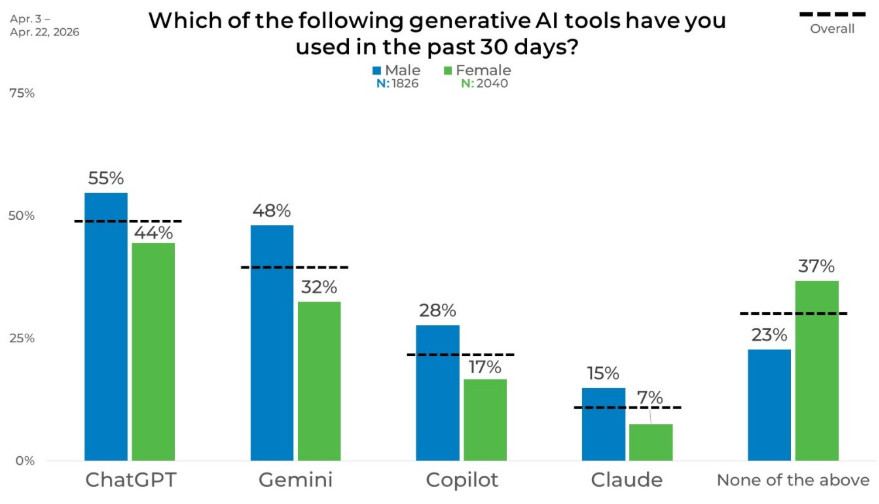
A clear gender gap emerges across the generative AI landscape, with men reporting higher usage than women for every tool measured. The difference is most noticeable for the two dominant platforms: 55% of men say they used ChatGPT in the past 30 days, compared with 44% of women, while Gemini shows an even larger gap at 48% versus 32%.
That pattern isn’t limited to the biggest names. Men are also more likely to use tools like Copilot and Claude, suggesting they’re engaging with a wider range of AI platforms overall, not just the market leaders.
Age
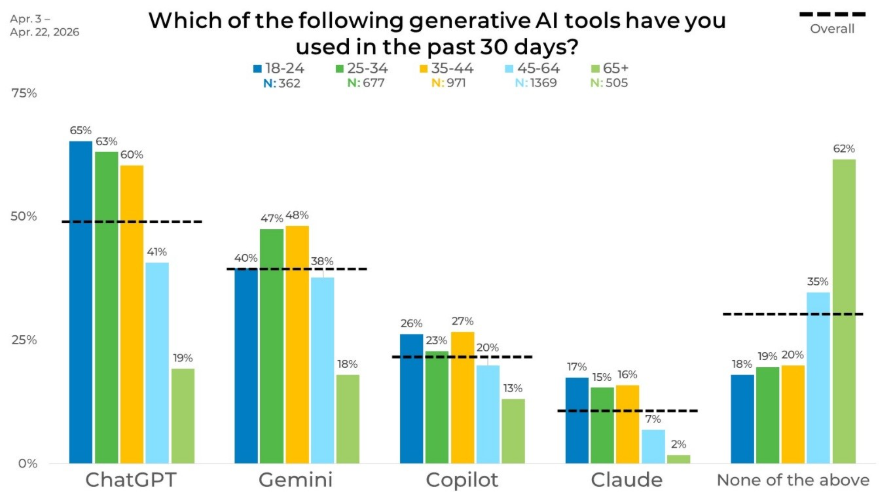
Age is one of the clearest dividing lines in generative AI adoption, with usage dropping steadily as age increases. ChatGPT is a good example: around six in ten adults under the age of 45 reports using it, compared with 41% of those agesd 45–64 and just 19% of adults 65 and older. Put simply, younger adults are far more likely to have AI as part of their daily digital toolkit.
That same age gap shows up across the rest of the AI landscape. Gemini, Copilot, and Claude all see their strongest usage among younger and middle-aged adults, while adoption falls sharply among older respondents. Claude, for instance, drops from 17% among 18–24-year-olds to only 2% among those 65 and older.
The contrast becomes even sharper when looking at non- users. Just 18% of adults ages 18–24 reported using no generative AI tools in the past 30 days, compared with 62% of those 65 and older.
Income
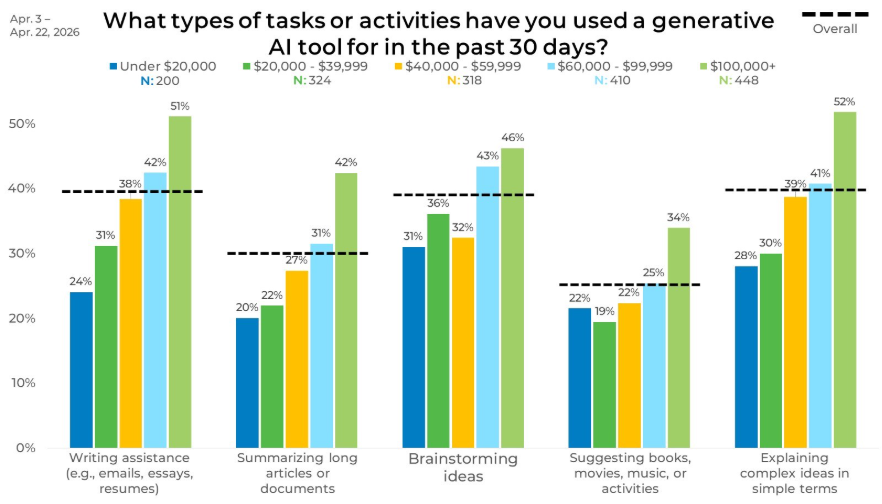
Looking at income, one pattern stands out immediately: the higher the income, the higher the use of generative AI across every platform measured. ChatGPT usage rises from 36% among respondents earning under $20,000 to 68% among those earning $100,000 or more, with a steady climb between those points.
That same upward trend appears across all other tools as well. Gemini increases from 30% at the lowest income level to 53% at the highest, while Copilot and Claude show even steeper growth, rising from 11% to 38% and from 5% to 21% respectively.
Non- use moves in the opposite direction, falling sharply from 41% among the lowest income respondents to 16% among the highest income group.
Political affiliation
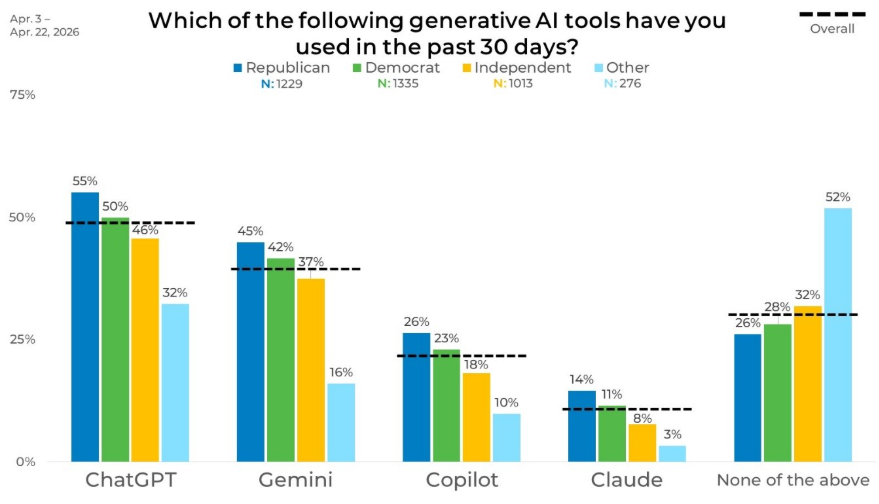
Political affiliation shows a consistent ranking across all generative AI tools, with Republicans and Democrats generally reporting the highest usage. ChatGPT leads at 55% for Republicans and 50% for Democrats, followed by Independents at 46%.
The same pattern appears across Gemini, Copilot, and Claude, with Republicans and Democrats consistently higher and Independents lower across each tool.
Non -use moves in the opposite direction, from 26% among Republicans and 28% among Democrats to 32% among Independents, reinforcing the overall pattern of slightly lower adoption among Independents compared with the two major parties.
Region
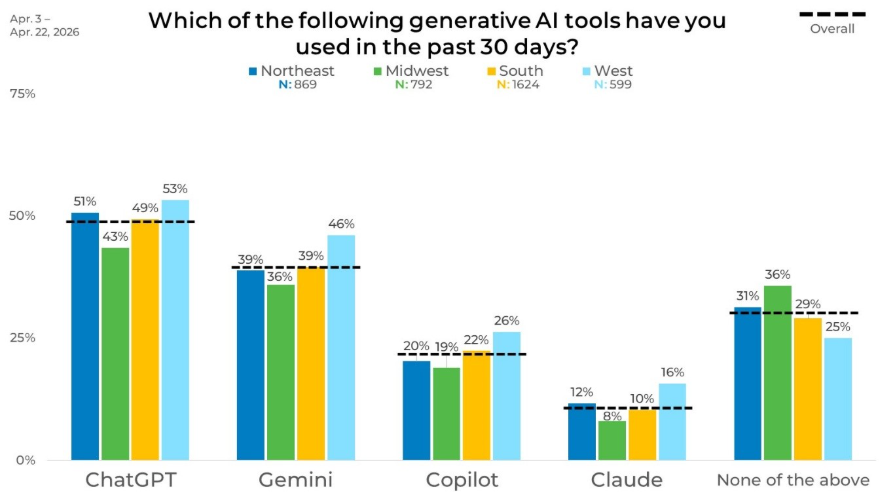
Regional differences in generative AI adoption are noticeable, but they are not dramatic. For ChatGPT, usage ranges, with the highest in the West at 53% to the Midwest, which is the lowest at 43%.. Gemini shows a similar pattern, with the West and Midwest having the highest and lowest usage respectively.
Non-use reinforces the same story in reverse: it is highest in the Midwest at 36% and lowest in the West at 25%.
Ethnicity
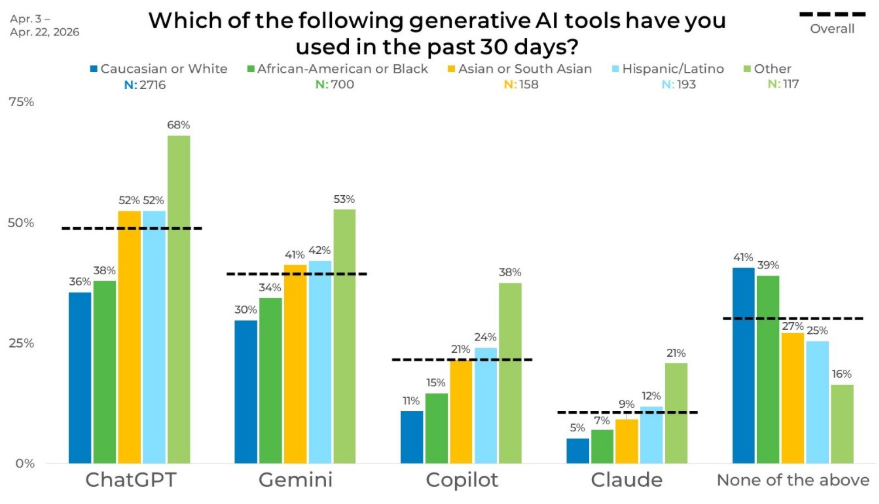
Across ethnic groups, ChatGPT remains the most widely used generative AI tool by a clear margin. Usage ranges from 36% among Caucasians to 68% among respondents in the “Other” category, making it the most common entry point into the AI landscape regardless of group. That widespread also suggests that while awareness of these tools is broad, the pace of adoption is not the same across every segment.
Panel
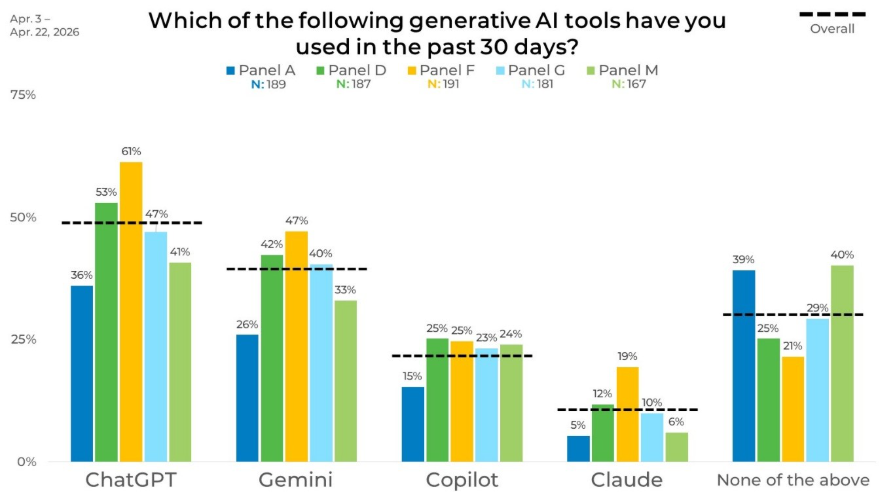
One of the clearest patterns in the data is how strongly Panel F’s usage rate stands out. It posts the highest usage across the major generative AI tools, with 61% using ChatGPT, 47% using Gemini, and 19% using Claude. At the other end of the spectrum, Panel A consistently reports the lowest adoption, at 36% for ChatGPT, 26% for Gemini, and 5% for Claude. The contrast is especially striking for ChatGPT, where Panel F leads Panel A by 25 points, while Gemini shows a similarly large 21-point gap. Taken together, these differences point to a much stronger overall level of AI engagement in Panel F.
Generative AI usage today is defined by rapid adoption and clear concentration. A small number of platforms, led by ChatGPT and followed by Gemini, account for most use, while a significant share of respondents still report no engagement with these tools.
Across time and demographics, adoption varies consistently, with younger, higher income, and more digitally engaged groups leading usage. Political differences are more limited, suggesting that behavior and access play a larger role than ideology. Overall, the market remains in transition, with strong leaders and ongoing competition among a small set of platforms. Connect with EMI to explore these findings in more depth and discuss what they mean for your strategy.