

Inside the Generative AI Boom: Who’s Using What
June 17, 2026
The Right Tool for the Right Job: Preferred AI Tools Across Common Tasks
June 22, 2026
Generative AI is increasingly being used as a practical tool across a wide range of everyday tasks, with clear patterns emerging in how people engage with it. At its launch, people were using it to create funny images, or have it write things in a certain style. But as the technology has evolved, so as its uses with consumers.
In our recent round of research-on-research, we wanted to understand what tasks consumer are using generative AI for, and if we have seen any changes since our previous wave. Let’s dive in.
Overall
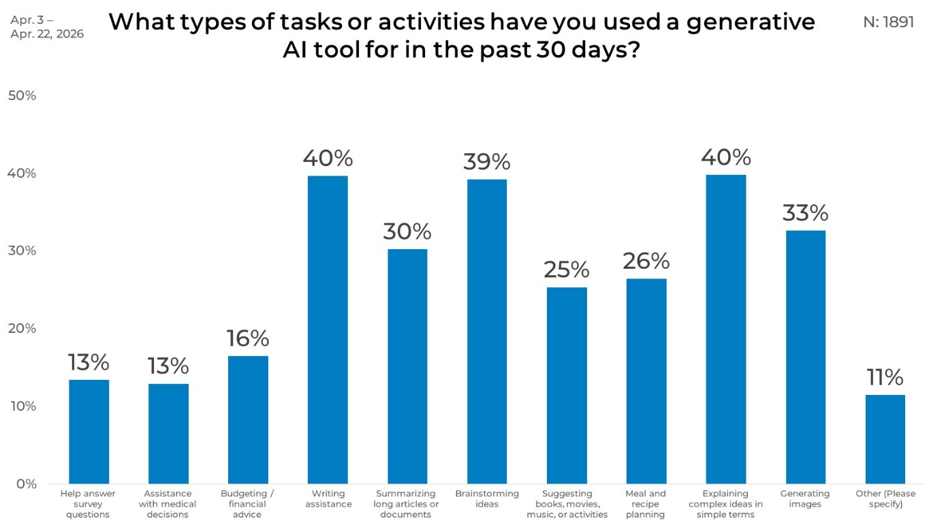
Generative AI has become part of consumers’ daily lives, not just something they occasionally use on a laptop or device. Among respondents who had used a generative AI tool in the past 30 days, the most common activities were getting help with writing, simplifying complex topics, and brainstorming ideas, with around 40% of respondents reporting each use case. While these cases may seem different, they all point to the same underlying need: helping people think through information and communicating ideas more effectively. Whether consumers are generating new ideas or turning their thoughts into written content; generative AI is being used as a tool to reduce the effort required to complete cognitive tasks
Wave Over Wave
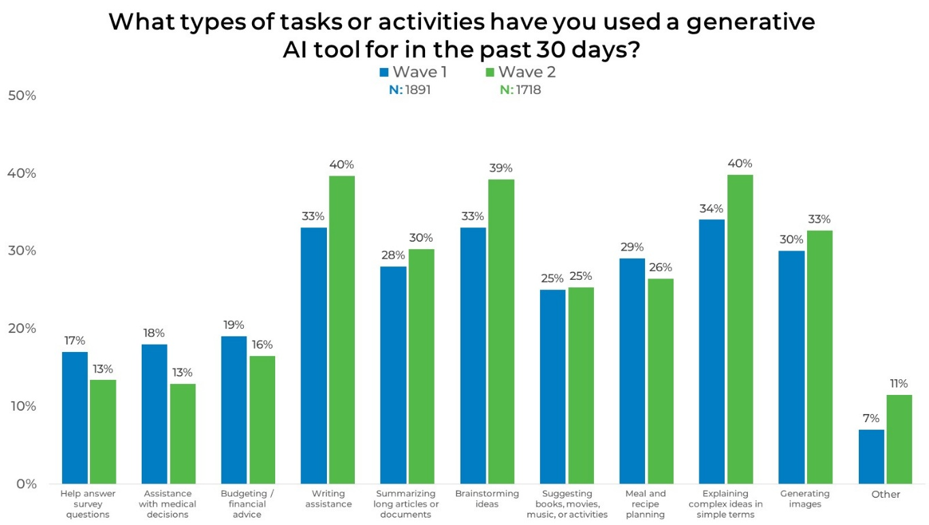
From Wave 1 to Wave 2, generative AI use shifted further toward everyday tasks, with the strongest growth in communication, comprehension, and idea generation.
Writing assistance saw the largest increase, rising from 33% to 40%. Explaining complex ideas in simple terms also grew 6 points, from 34% to 40%. Together, these shifts suggest that people are increasingly using generative AI to understand information and turn it into clear communication. Brainstorming also rose, from 33% to 39%, reinforcing the same pattern. Rather than serving mainly specialized needs, generative AI appears to be expanding as a tool for developing ideas and thinking through problems more broadly.
At the same time, not every category increased. The category “help answering survey questions” fell from 17% to 13%, medical decision assistance dropped from 18% to 13%, and budgeting or financial advice declined from 19% to 16%.
Gender
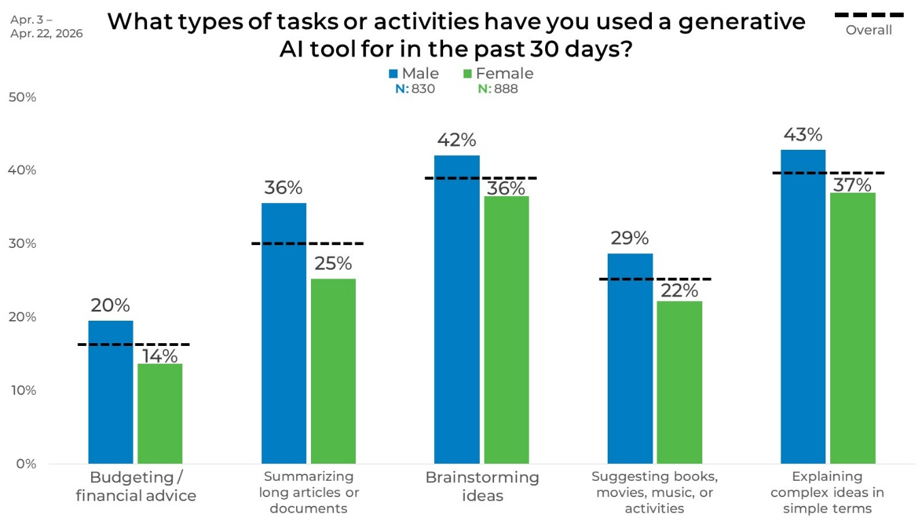
Across every use case measured, men report using generative AI more often than women, though the biggest differences show up in just a few kinds of tasks.
The clearest divide appears in tasks that require sorting through a lot of information. For instance, 35% of men say they use AI to summarize long articles or documents, compared with 25% of women. A similar pattern shows up in budgeting or financial advice, where men are also more likely to report using generative AI. These findings suggest that men are somewhat more likely to turn to AI when they need help processing information, weighing options, or reaching decisions more efficiently.
That same pattern carries into more everyday uses, though the gaps are narrower. Men are slightly more likely than women to use AI for brainstorming ideas (42% vs. 36%) and explaining complex topics in simple terms (43% vs. 37%). Even in these more familiar tasks, the pattern points in the same direction: men appear somewhat more likely to use AI as a tool for working through ideas from the earliest stages of thinking.
Age
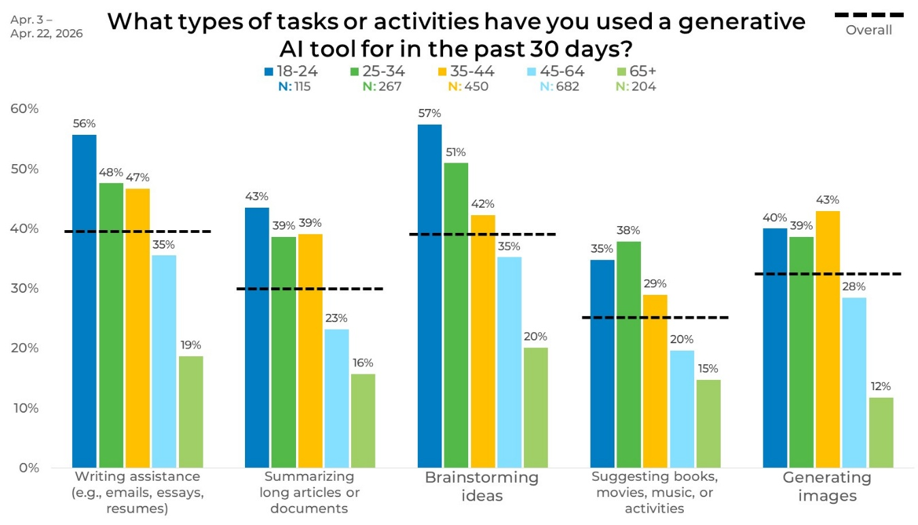
Age is one of the clearest dividing lines in generative AI use, the younger respondents report higher usage in every category, with use generally falling as age increases.
That pattern is especially visible in writing and idea-generation tasks. Use of AI for writing assistance drops steadily from 56% among ages 18–24 to 19% among those 65 and older, while brainstorming falls from 57% to 20% across the same age range. In other words, younger adults are far more likely to use AI at the earliest stages of thinking, drafting, and shaping ideas.
The same age gradient appears across other use cases as well. Summarizing long articles drops from 43% among the youngest respondents to 16% among the oldest, while image generation and entertainment recommendations also peak among younger or middle-aged adults before tapering off among older groups. Taken together, the findings show that younger users engage with generative AI more consistently across both practical and creative tasks.
Income
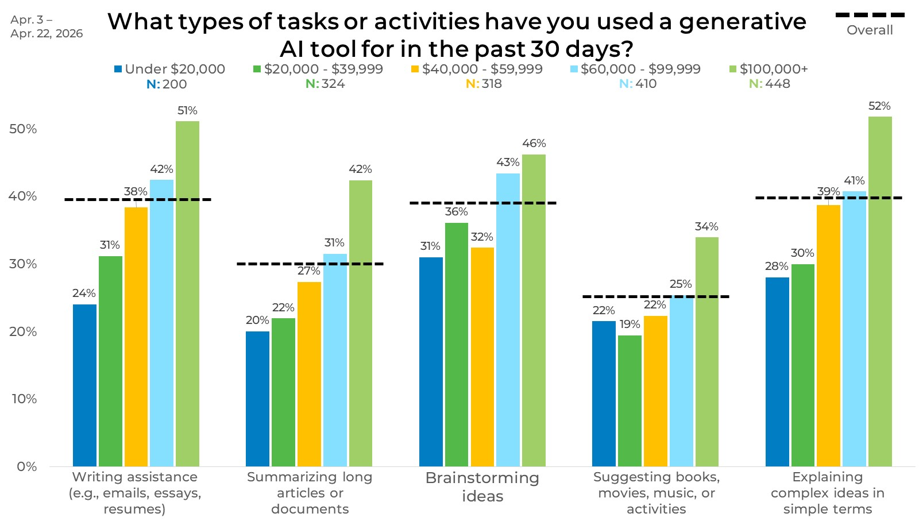
Income is another clear marker of generative AI use, with higher-income respondents reporting higher use across nearly every category. The pattern is especially noticeable in writing assistance, which rises from 24% among households earning under $20,000 to 51% among those earning $100,000 or more.
The same pattern appears in tasks centered on understanding and processing information. Use of AI for summarizing long articles rises 22 points, while use for explaining complex ideas in simple terms increases from 28% to 52%, with top earners consistently reporting the highest levels of use.
Higher-income respondents also report greater use of more open-ended tasks like brainstorming, which peaks at 46% among those earning $100,000 or more, and content recommendations, which reaches 34% in the highest income group. Overall, the pattern suggests broader engagement with generative AI across both practical and creative uses.
Political Affiliation
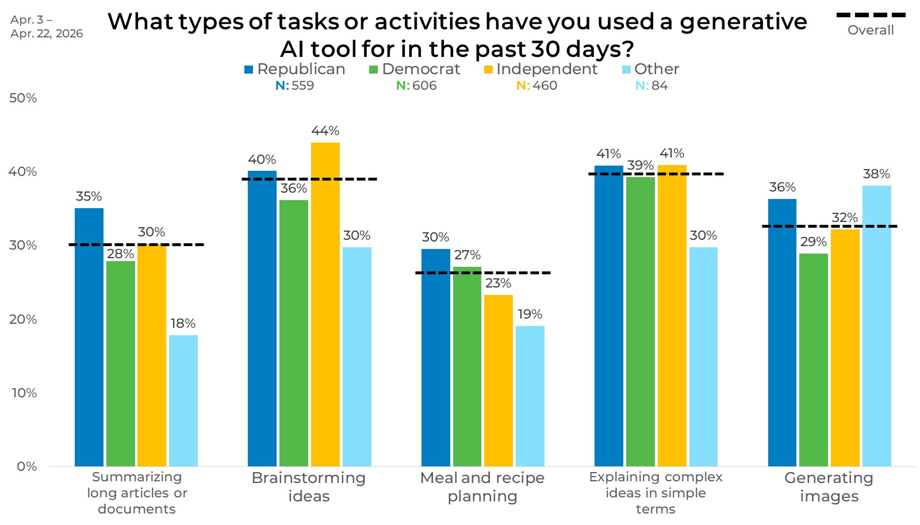
Across political affiliation, explaining complex ideas is one of the most common uses of generative AI, with Republicans and Independents both at 41%, Democrats following close at 39%, and other respondents lower at 30%. Brainstorming shows a similar pattern, led by Independents at 44%, followed by Republicans at 40% and Democrats at 36%, highlighting strong use of AI for idea generation across all groups.
A second pattern shows more practical, structured uses like summarizing and meal planning. Republicans lead in summarizing long documents at 35%, with Independents at 30% and Democrats at 28%, while meal planning ranges from 30% among Republicans down to 19% among other respondents, showing slightly lower but still consistent engagement.
Idea generation is the most variable use, highest among other respondents at 38% and close across Republicans (36%), Independents (32%), and Democrats (29%). Overall, the chart shows AI use clustering around explaining, brainstorming, and summarizing, with more variation in creative tasks like image generation.
Region
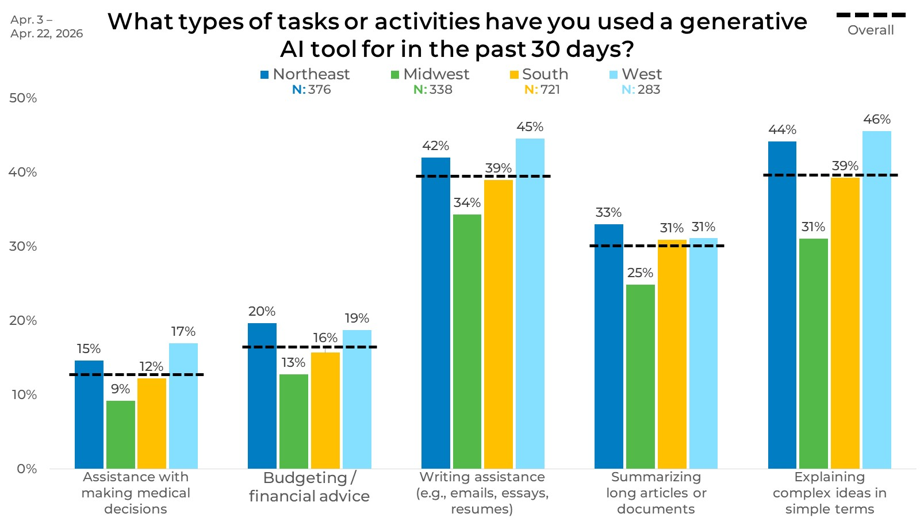
Regional differences are consistent across every use of generative AI in the data, with the West and Northeast usually coming out on top and the Midwest lower across the board. You see it right away with explaining complex ideas, where the West (46%) and Northeast (44%) lead the South (39%) and Midwest (31%), and the same pattern shows up again in writing assistance with the West (45%) and Northeast (42%) ahead of the South (39%) and Midwest (34%).
That same ordering carries into more practical uses too, like medical decision help and budgeting. Medical assistance is highest in the West (17%) and Northeast (15%) and lowest in the Midwest (9%), with the South in between (12%). Budgeting follows a similar split, from 20% in the Northeast and 19% in the West down to 16% in the South and 13% in the Midwest.
Even summarizing long articles fits into that same pattern, led by the Northeast at 33%, followed by the South and West at 31%, and the Midwest at 25%. Overall, it’s the same story repeating itself: the West and Northeast tend to lead, the Midwest lags, and the South sits in the middle, no matter the task.
Ethnicity
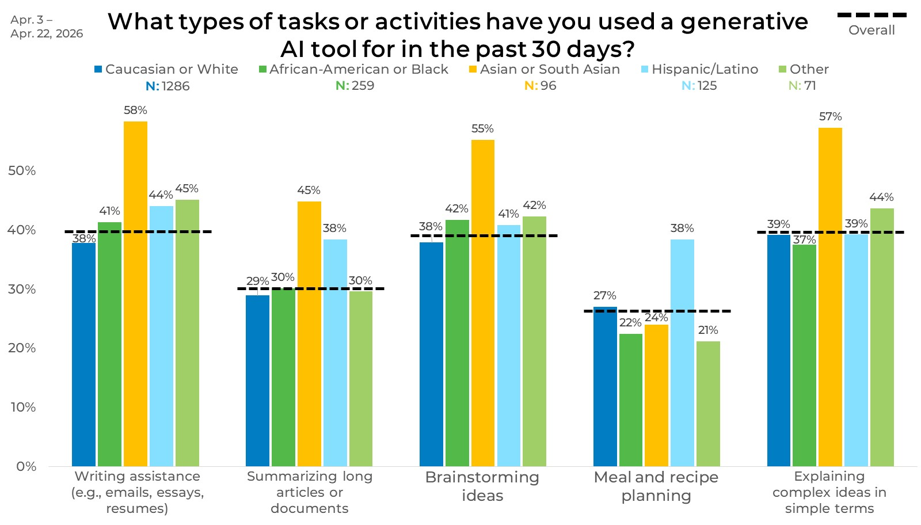
Across race and ethnicity, Asian respondents stand out as the most frequent users across several key AI tasks. They lead in writing assistance at 58%, explaining complex ideas at 57%, and brainstorming at 55%, consistently sitting above all other groups in these core uses.
Other groups tend to cluster a bit lower and closer together on these same tasks. For example, writing assistance ranges from 45% among other respondents down to 38% among Caucasian respondents, while brainstorming sits between 38% and 42% across Hispanic, African American or Caucasian respondents.
There are also a few task-specific differences that break the pattern. Summarizing long documents is again highest among Asian respondents at 45%, followed by Hispanic respondents at 38%, while meal and recipe planning flips the ranking, with Hispanic respondents highest at 38% and Asian respondents lower at 24%. Overall, Asian respondents lead in most text-heavy and idea-generation tasks, while other groups are more evenly spread and tend to peak in more specific use cases.
Panel
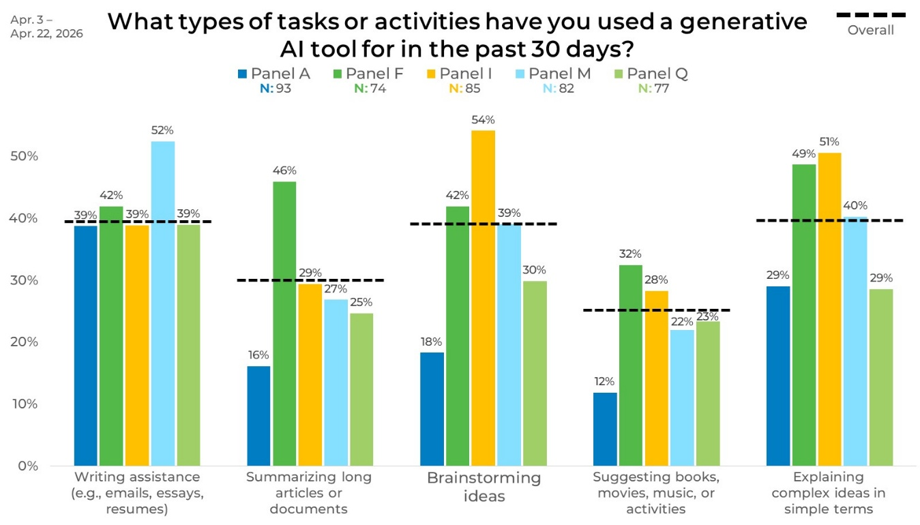
The panel results show clear variation across respondent groups, making them best understood as side-by-side comparisons rather than a single overall pattern. Writing assistance is highest in Panel M at 52%, followed by Panel F at 42%, while Panels A, I, and Q are all lower at 39%.
That split becomes even clearer in more information-heavy uses. Panel F stands out for summarizing long articles or documents at 46%, while Panel I leads in brainstorming at 54% and also performs strongly in explaining complex ideas at 51%. Panel F also performs well in explanation (49%), while Panel A consistently sits at the lower end across these tasks.
Across more creative and recommendation-based uses, the same divergence continues, with suggestions for books, movies, music, or activities ranging from 32% in Panel F down to 12% in Panel A. Taken together, the results don’t point to one dominant panel across all uses, but rather a consistent pattern of different strengths emerging depending on the task.
Generative AI is now firmly part of everyday use, most often supporting writing, explaining information, and brainstorming. While usage is broadly consistent, differences across age, income, region, and other groups show that adoption is still uneven even as it grows.
As these tools continue to evolve, understanding who is using them and how consumers utilize the resources will be key to anticipating where adoption goes next. For additional insights or to discuss how these trends may shape your business or research, click the button below to request a consultation.