

Think the US Public Agrees on Iran? Think Again
April 21, 2026
The Endless Wait: Did TSA Wait Times Really Get Longer?
May 4, 2026
The current military strikes and blockade occurring in Iran have many people around the globe concerned. While support for the actions among US consumers is divided (see part 1), we also wanted to explore the level of concern about this conflict escalating. In part two, we asked US consumers about their level of concern that the current conflict could escalate into a larger regional or global war.
Let’s see what we uncovered.
Overall
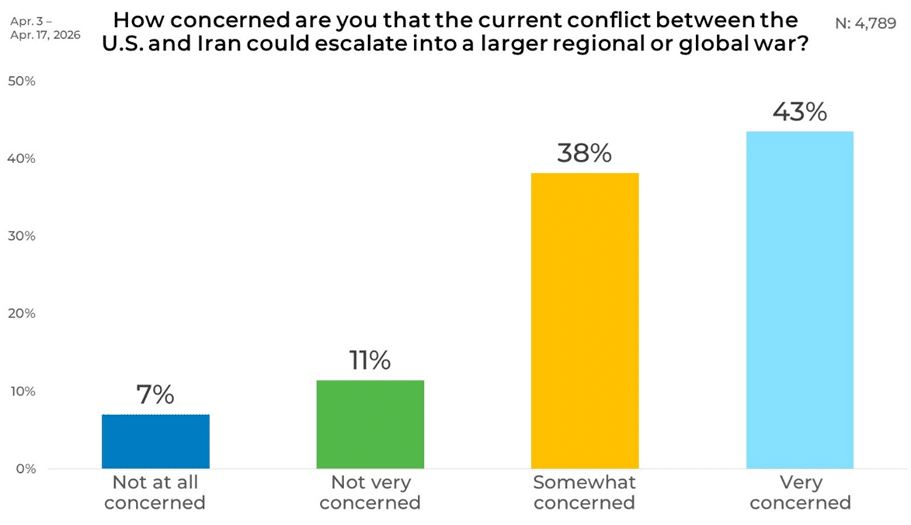
The concern that the current conflict will escalate is prominent among all respondents. A combined 81% of respondents report being either somewhat concerned (38%) or very concerned (43%) about the possibility of the conflict expanding into a larger war. Within this group, the largest single share falls into the highest level of concern, with 43% indicating they are very concerned. By contrast, smaller portions of the population express limited worry, with 11% saying they are not very concerned and just 7% reporting they are not at all concerned.
Gender
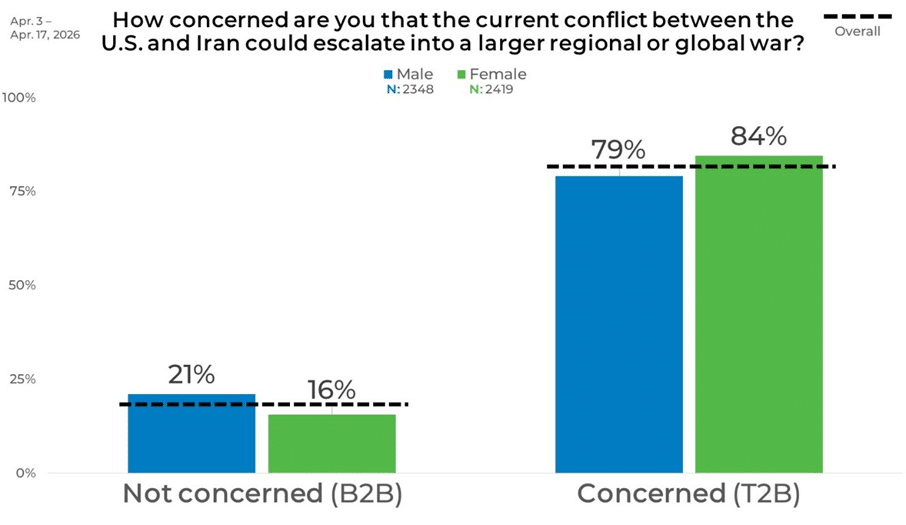
Concern levels are high for both men and women, though women show slightly higher overall concern. Among male respondents, 79% fall into the top two boxes (concerned), compared with 84% of female respondents.
Age
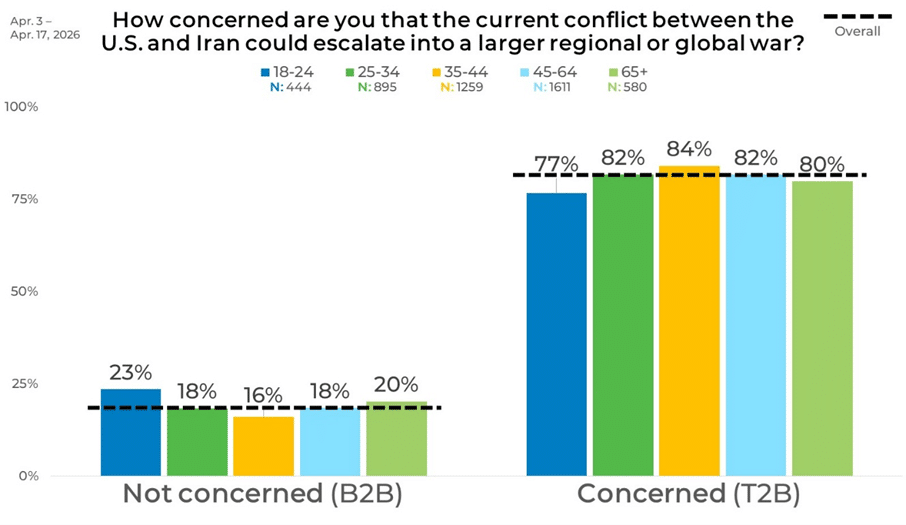
When segmenting the data by age, we found a high level of concern across all age groups. Respondents ages 35–44 report the highest level of concern at 84%, while those ages 25–34 and 45–64 both register 82%. The youngest group, ages 18–24, shows slightly lower concern at 77%, though this still represents more than three-quarters of respondents.
Income
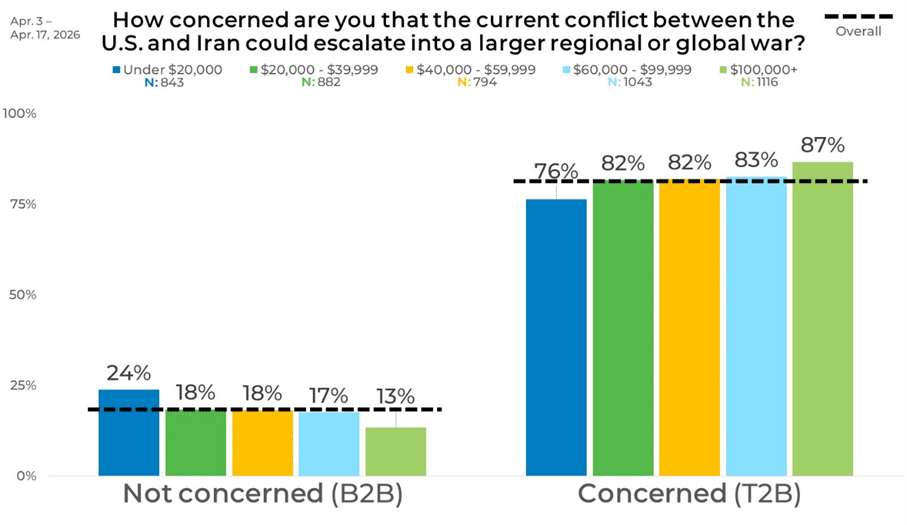
Breaking down the data by income, we see that the escalation concern generally increases as household income rises. Among respondents earning under $20,000, 76% are concerned and 24% are not concerned. This share grows steadily across income brackets, reaching 82% among those earning between $20,000 and $59,999, and 83% among those earning between $60,000 and $99,999. The highest-income group, earning $100,000 or more, shows the greatest level of concern at 87%.
Political Affiliation
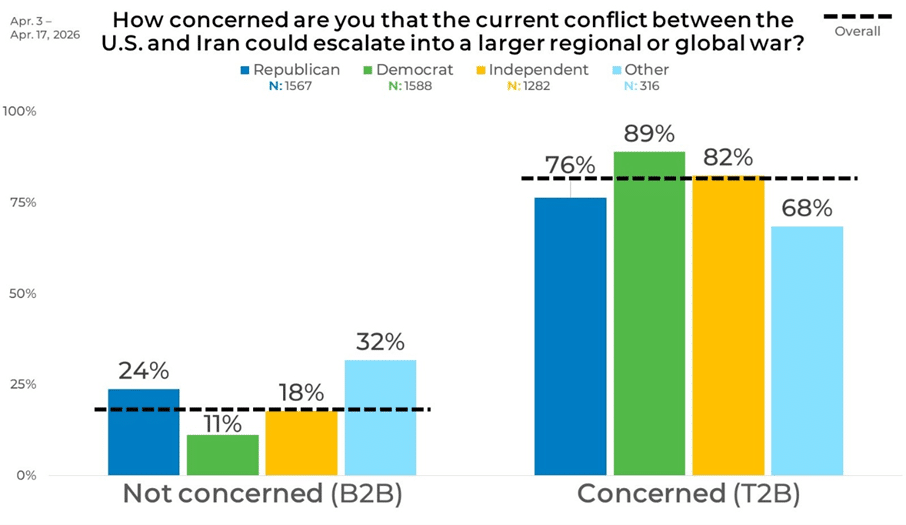
There are some noticeable difference in the level of concern regarding escalation when we look at political affiliation. Democrats show the highest level of concern, with 89% classified as concerned, with Independents just behind them at 82%. Republicans register somewhat lower concern compared with these groups, though still a clear majority at 76% concerned.
Panel
The biggest differences we found in the data were by panel source. There is a 26-point difference in concern that the conflict will escalate between Panel W and Panel N. Panels I and C fall closer to the higher end at 85% and 82%, while Panel Q registers 79% concerned.
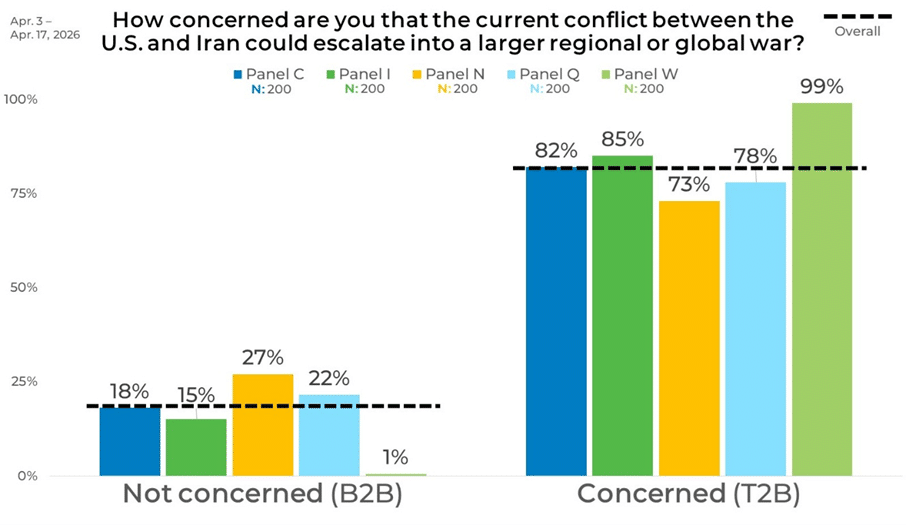
This data highlights the need to strategically blend panel sources to best mitigate any potential bias form panel source. To learn more about how to do this, click the button below.