
Support on Policy Doesn’t Equal Support on Enforcement Tactics: A Deep Dive into Opinions on Deportation and ICE Tactics
May 5, 2026
Spring Conference Recap
May 7, 2026
A couple of months ago, Anthropic made headlines when asked for assurances from the Department of Defense (DOD) that they would not use its AI models for fully autonomous weapons or mass domestic surveillance. The DOD wanted Anthropic to give it unrestricted access. This led to a fight between the two that played out in the media and ultimately resulted in Anthropic being designated a “supply chain risk” by the DOD.
We wanted to better understand how people felt about this, so we asked in our recent round of research-on-research.
Let’s see how people feel about this.
Overall
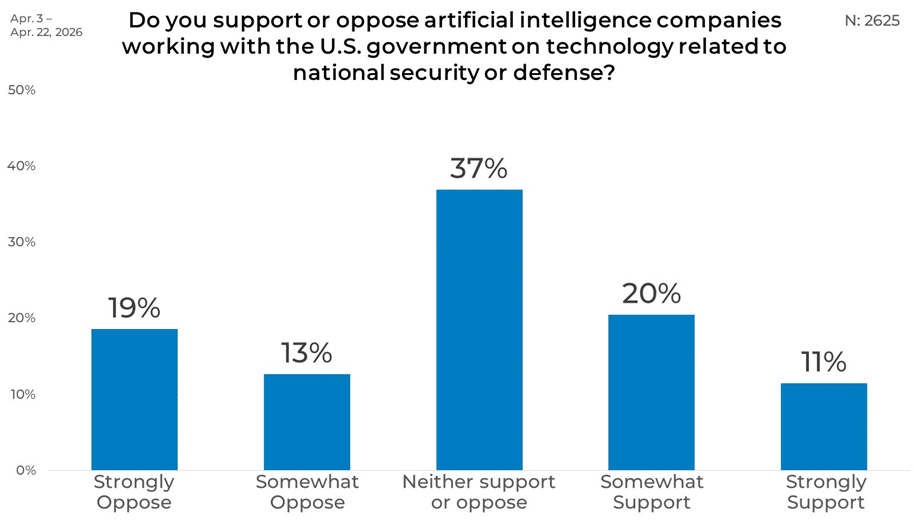
Across the top line results, support is evenly distributed. 32% of respondents oppose AI firms working with the government on technology related to national security or defense, while 31% support. The highest percentage of respondents (37%) is in the middle.
Gender
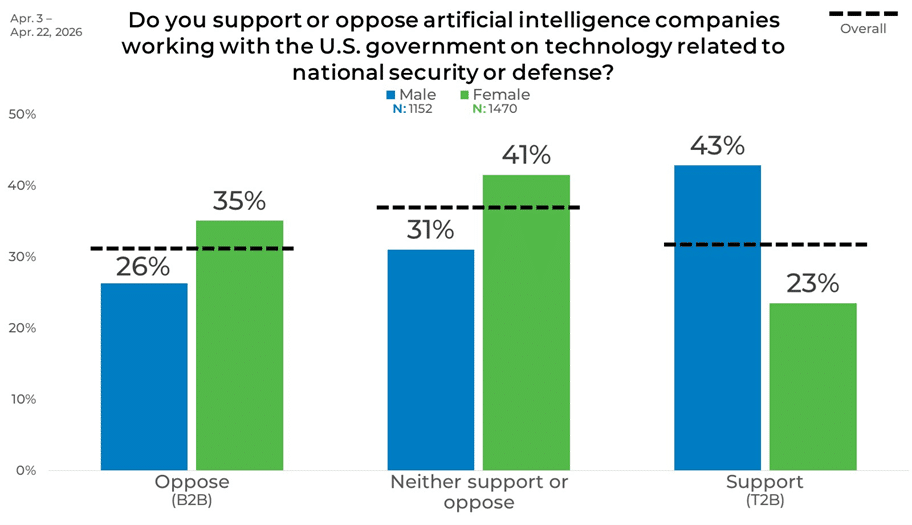
Men have a significantly higher level of support for AI firms working with the government on technology for national security or defense, 20 points higher than women. Women are more likely to be neutral or opposed. The largest share of women, 41%, neither support nor oppose the idea, while 35% oppose it and 23% support it.
Age
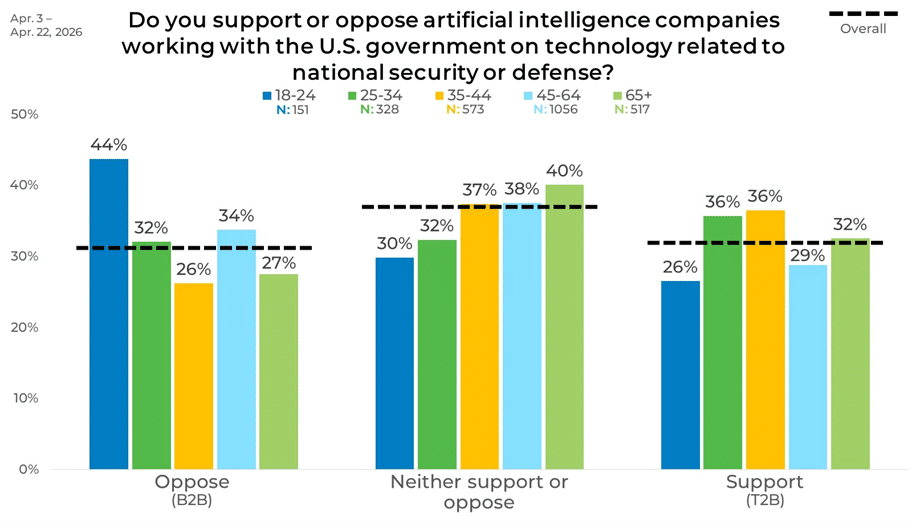
Segmenting that data by age highlights that respondents aged 18-24 have the highest level of opposition to AI firms working with the government, 10 points higher than any other age group.
Neutrality seems to increase with age, as the levels rise 10 points between respondents aged 18-24 and those aged 65+.
Respondents aged 25-44 express the highest level of support, with 36%. This is 3 to 10 points higher than other age groups.
Income
Support and opposition exhibit divergent patterns when broken down by income levels. Support for AI companies working with the government on technology for national security or defense rises as income increases. Alternatively, opposition increases as income declines.

Political Affiliation
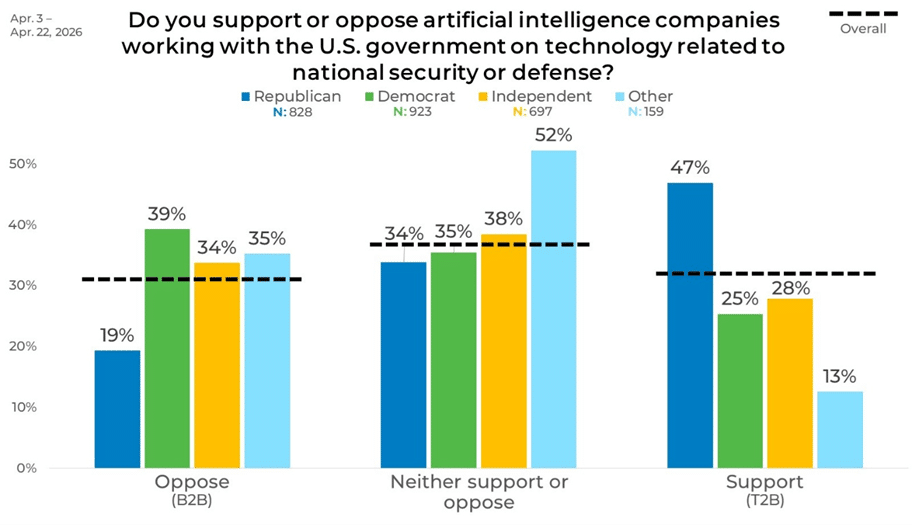
Republicans show the highest level of support among the political groups. Nearly half, 47%, support AI companies working with the U.S. government on national security or defense technology, compared with 19% who oppose it. Republican support is 28 points higher than the opposition.
Democrats are more opposed than supportive, with 39% opposed and 25% supportive, while 35% neither support nor oppose the idea. Independents follow a similar pattern but with a smaller gap: 34% oppose it, 28% support it, and 38% are neutral.
Ethnicity
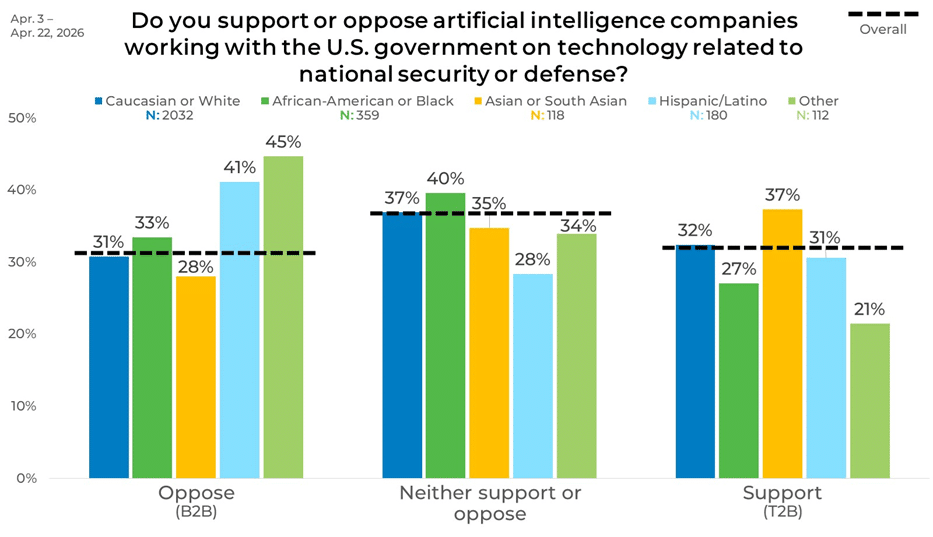
Support levels vary when the data is broken down by ethnicity. For Caucasians, views are closely divided: 31% oppose the idea, and 32% support it. African American respondents are more likely to be neutral, at 40%, with 33% opposed and 27% supportive.
Asian respondents show the highest support at 37%, compared with 28% opposition. Hispanics have the highest opposition among the named groups, at 41%.
Panel
Looking at the data segmented by panel source shows that neutrality has the highest percentage across most panels. There are pockets of differences. The largest difference between panels is support. Panel B has the highest support, at 42%, while Panel H has the lowest support, at 22%, a 20-point gap. Panel H has the highest opposition, at 39%, 17 points higher than Panel B.
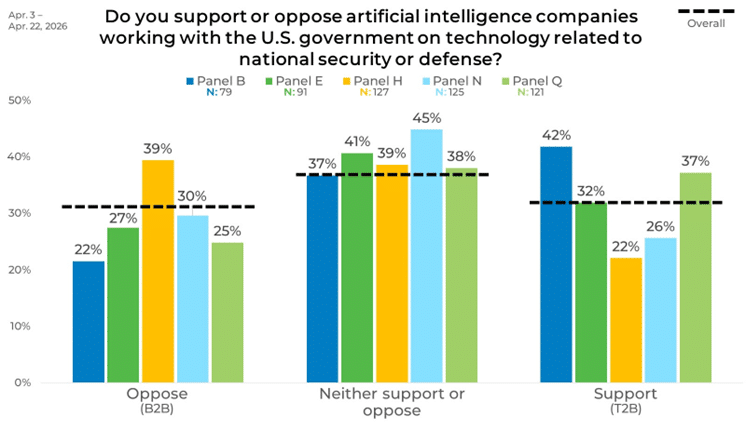
Once again, this data highlights the need to blend panel sources beyond just demographically, but by attitudes and behaviors, to truly get a representative sample. To learn how EMI does it, click the button below.