

From Writing to Brainstorming: Is the Way People Are Actually Using AI Changing?
June 19, 2026
A Nation Divided on the Economy: Beyond the Numbers
June 24, 2026
Artificial intelligence tools are increasingly used for a wide range of everyday activities, from writing and research to coding and image creation. To understand how people approach these tasks, we asked respondents in our most recent wave of research-on-research which AI tool they prefer to use for several common applications. Let’s see what we found.
Overall
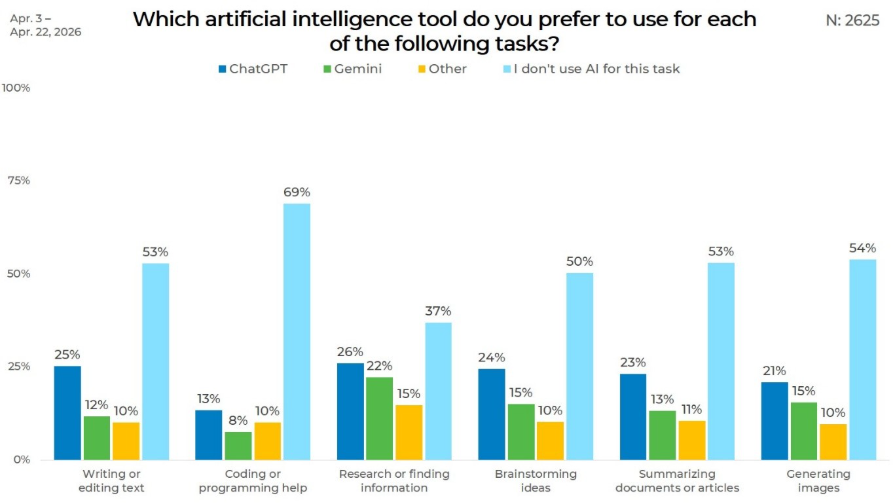
Across all six tasks, a large share of respondents reported not using AI at all. The highest levels of non-use appeared in coding or programming help, where 69% said they do not use AI for the task. Even for research, the category with the broadest AI adoption, 37% still reported not using AI.
Among individual platforms, ChatGPT consistently led. It was the most commonly preferred tool for research or finding information at 26%, followed closely by writing or editing text at 25% and brainstorming ideas at 24%. ChatGPT also led for summarizing documents or articles (23%) and generating images (21%). Gemini ranked second in most categories, reaching 22% for research and 15% for both brainstorming and image generation. Other AI tools accounted for between 10% and 15% depending on the task.
Gender
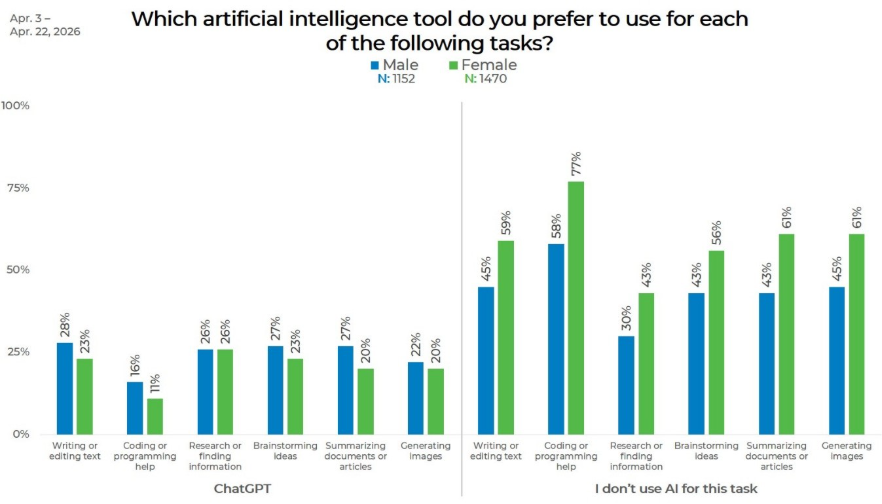
Men reported higher ChatGPT usage than women across nearly every task. The largest gaps appeared in summarizing documents or articles, where 27% of men preferred ChatGPT compared with 20% of women, and coding or programming help, where the figures were 16% and 11%, respectively.
Research was the lone category with no gender difference, with both men and women reporting 26% ChatGPT preference. Non-use rates were consistently higher among women. For example, 77% of women said they do not use AI for coding help compared with 58% of men. Similar gaps appeared for summarization (61% versus 43%), image generation (61% versus 45%), and writing or editing text (59% versus 45%).
Age
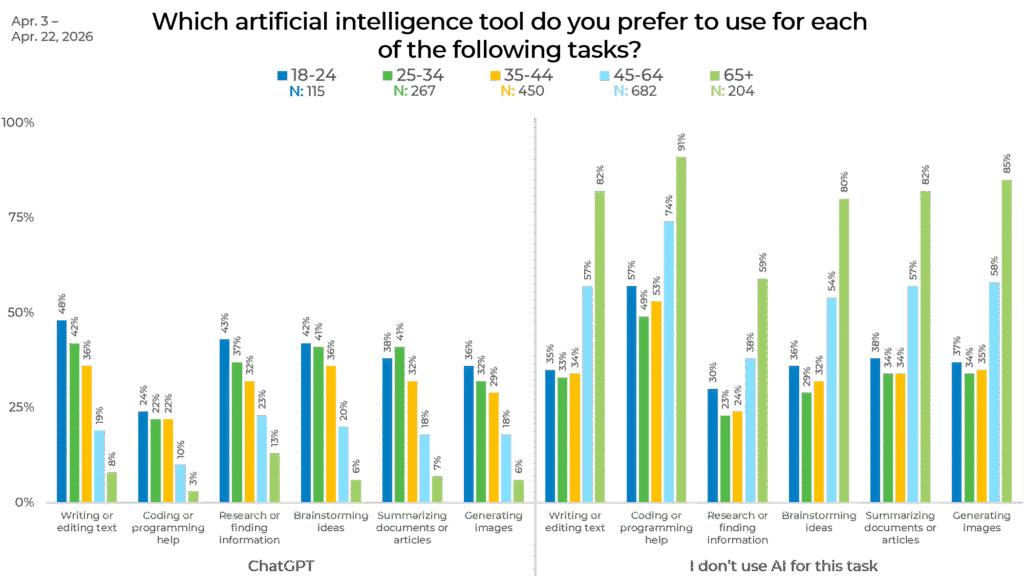
Age produced some of the largest differences in the results. Younger adults reported substantially higher ChatGPT usage across every task. Among those ages 18 to 24, 48% preferred ChatGPT for writing or editing text, while 43% used it for research and 42% for brainstorming ideas. Respondents ages 25- to- 34 reported similarly high adoption levels.
Usage declined steadily with age. Among adults 65 and older, only 8% preferred ChatGPT for writing, 13% for research, 6% for brainstorming, and 3% for coding help. At the same time, non-use increased sharply. Eighty-two percent of respondents ages 65 and older said they do not use AI for writing or summarization, 85% did not use AI for image generation, and 91% did not use AI for coding assistance.
The contrast is especially visible in writing tasks, where ChatGPT preference falls from 48% among the youngest adults to 8% among the oldest, while non-use rises from 35% to 82%.
Income
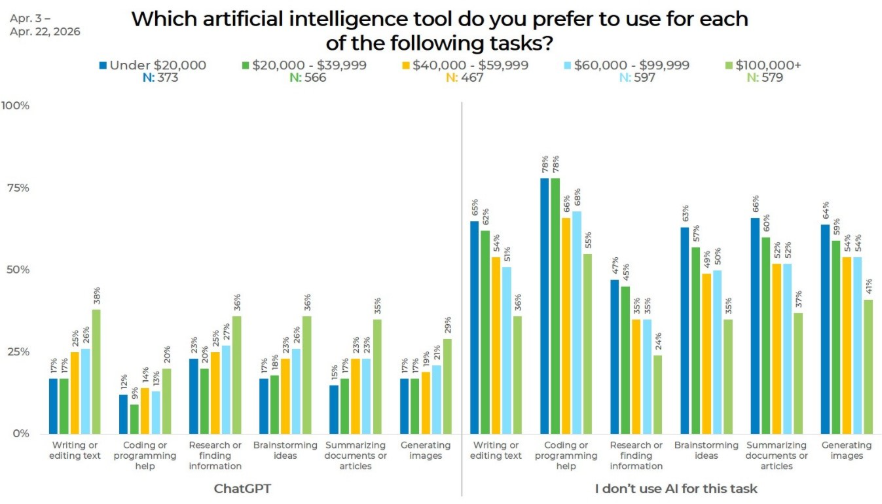
Higher-income respondents were considerably more likely to use ChatGPT. Among those earning $100,000 or more annually, 38% preferred ChatGPT for writing, 36% for research, 36% for brainstorming, and 35% for summarizing documents. These figures were roughly double those reported by respondents earning less than $40,000 in several categories.
Coding assistance showed one of the largest income gaps. Twenty percent of respondents in the highest income group preferred ChatGPT for coding help, compared with 9% among those earning between $20,000 and $39,999.
Political Affiliation
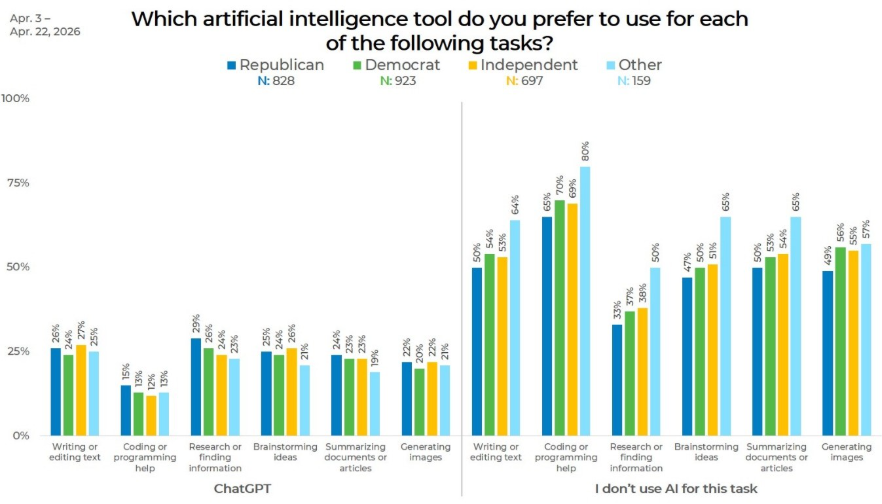
Political differences were relatively modest compared with other demographic categories. Republicans reported the highest ChatGPT usage for research at 29%, compared with 26% among Democrats and 24% among Independents. ChatGPT use for writing, brainstorming, summarization, and image generation varied only by a few percentage points across partisan groups.
The largest differences appeared among respondents identifying with another political affiliation. This group reported the highest rates of non-use across every task, including 80% for coding help and 65% for both brainstorming and summarizing documents. Republicans generally recorded the lowest non-use rates, while Democrats and Independents fell in between.
Region
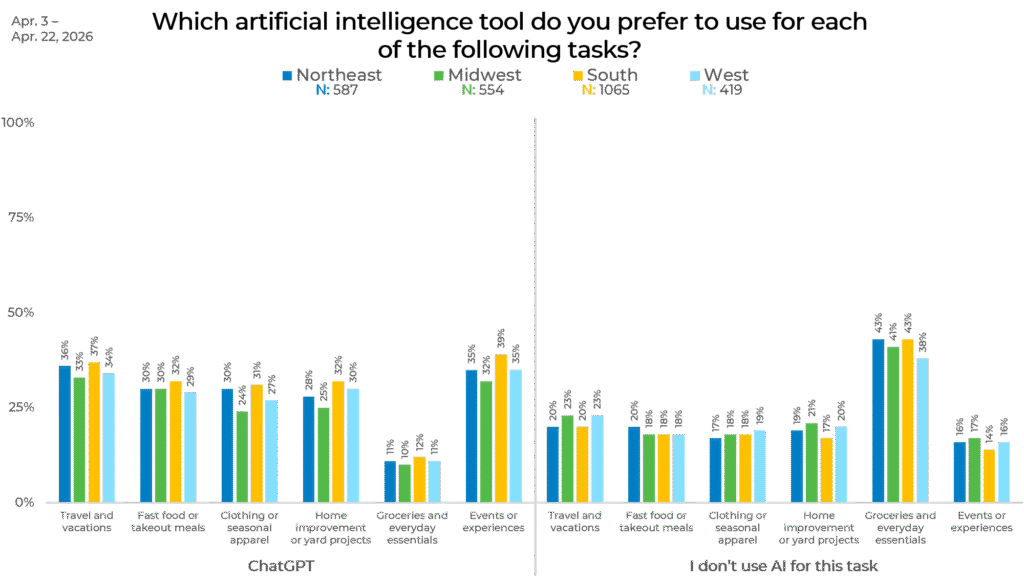
Regional differences were present but limited. Respondents in the West reported the highest ChatGPT usage for research or finding information at 30%, compared with 23% in the Midwest and 26% in both the Northeast and South. Western respondents also led in writing or editing text at 28%.
The Midwest consistently reported the highest levels of non-use. For coding help, 73% said they do not use AI, compared with 67% in the Northeast and 68% in both the South and West. Similar patterns appeared for brainstorming, summarization, and image generation, where Midwestern respondents were more likely than those in other regions to avoid AI tools entirely.
Ethnicity
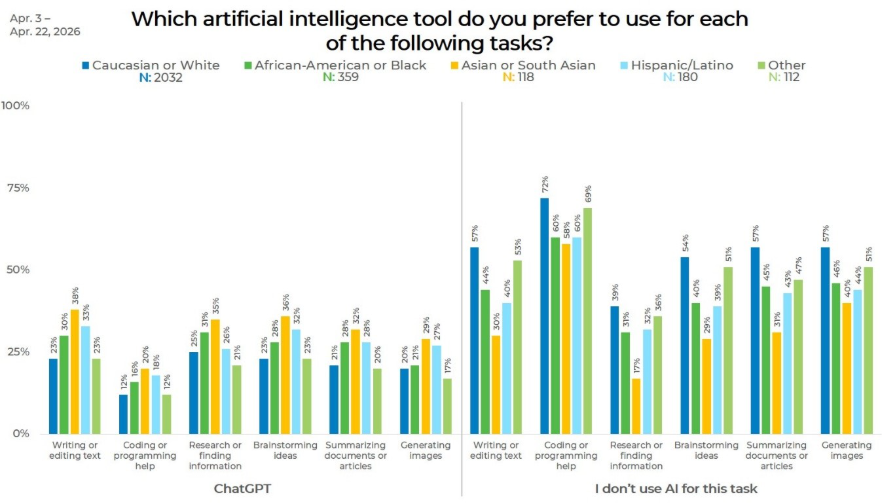
Asian respondents reported the highest ChatGPT usage across nearly every category. Thirty-eight percent preferred ChatGPT for writing or editing text, 36% for brainstorming ideas, 35% for research, and 32% for summarizing documents. They also recorded the lowest non-use rates, including just 17% for research and 29% for brainstorming.
Hispanic respondents also reported relatively high adoption, with 33% using ChatGPT for writing and 32% for brainstorming. African –American respondents generally fell between Hispanic and Caucasian respondents on most measures.
Caucasian respondents reported the lowest ChatGPT usage among the major racial and ethnic groups for several tasks, including writing (23%), brainstorming (23%), and summarization (21%). They also reported some of the highest rates of non-use, reaching 57% for writing, summarization, and image generation.
Panel
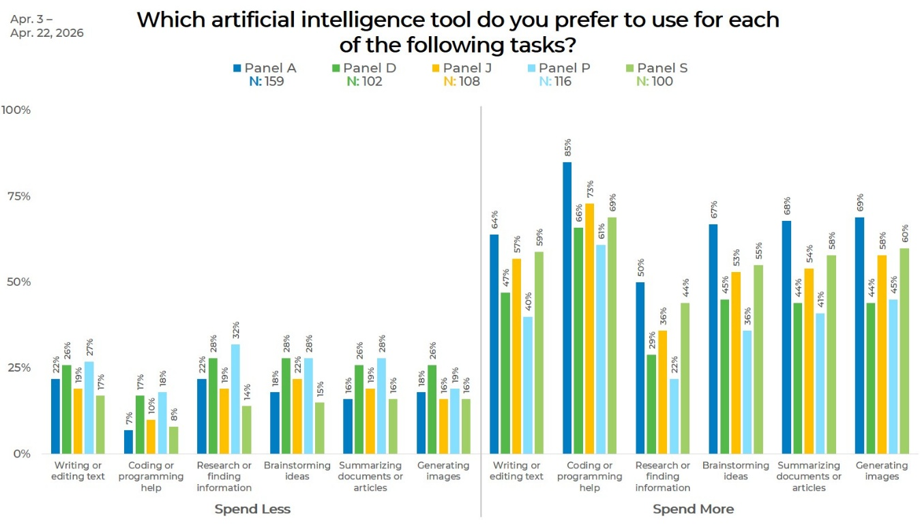
Panel results showed notable variation in AI use cases. Panel P consistently reported the highest ChatGPT usage across most categories, including 32% for research, 28% for brainstorming, 28% for summarization, and 27% for writing. Panel D also recorded relatively strong adoption levels.
Panel A reported the lowest levels of ChatGPT usage in several categories and the highest levels of non-use. Eighty-five percent of Panel A respondents said they do not use AI for coding help, while 69% did not use AI for image generation and 68% did not use AI for summarizing documents.
Panel S also reported comparatively low ChatGPT usage, particularly for research (14%), brainstorming (15%), and writing (17%). As with all panel-based comparisons, these results reflect differences among the survey panels themselves and can be viewed alongside the demographic findings to provide additional perspective on usage patterns.
These results highlight the need to blend your panel sources to mitigate any sample source bias. To learn more about EMI’s approach, click the button below.