

When Ho-Ho-Ho Turns to Oh-No: How to Field Online Surveys Through the Holiday Frenzy (2025 Edition)
November 3, 2025
Evolution of Data Quality: Inside the Largest Fraud Study Ever Conducted with Henry LeGard of Verisoul
November 10, 2025
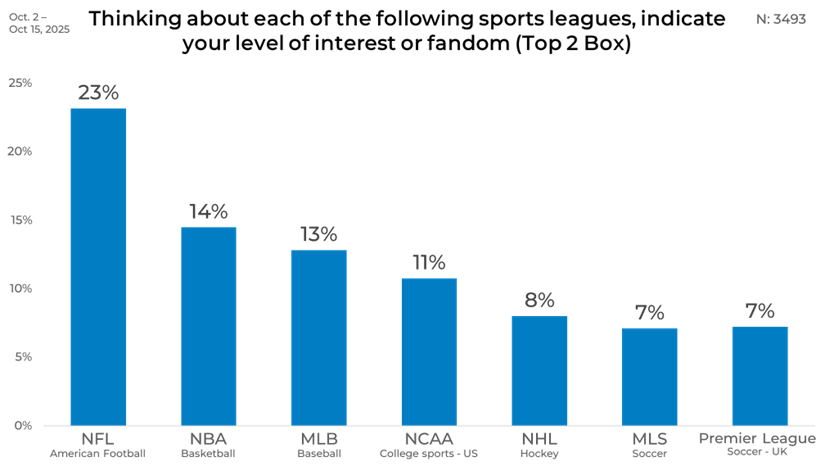
There’s nothing like sports to bring folks together and create that sense of community. In our recent wave of research-on-research, we explored the interest level of the different sports leagues to better understand which sports are bringing people together. Respondents rated their familiarity and enthusiasm for each league on a five-point scale, from I’ve never heard of it to I’m a die-hard/passionate fan.
Let’s dig into the results:
Overall
Across all the respondents, the NFL holds a commanding 23% top-two-box fandom score, doubling that of both the NBA (14%) and MLB (13%). College sports attract about one in ten respondents, and professional hockey sees an 8% fandom level. Soccer, whether represented by Major League Soccer or the Premier League, stands at 7% each, signaling niche yet steady engagement.
Gender
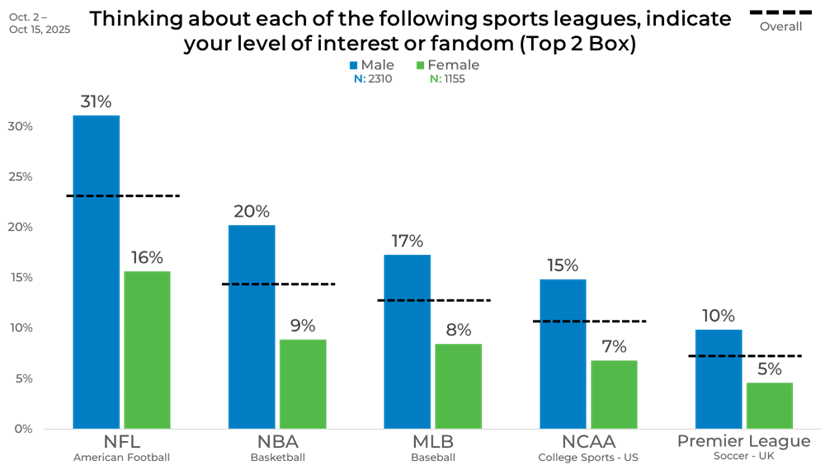
Gender plays a major role in shaping enthusiasm for different sports leagues. Men report significantly higher fandom across every major league, most notably for the NFL, where 31% identify as fans compared to 16% of women. The NBA and MLB also see substantial gaps, with male interest more than doubling that of female respondents. Even among college sports and the Premier League, male fandom consistently exceeds female engagement.
Age
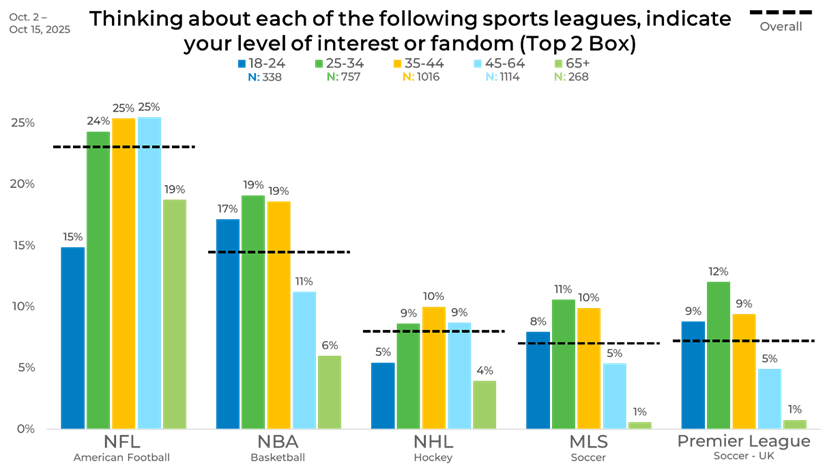
Gender plays a major role in shaping enthusiasm for different sports leagues. Men report Age reveals clear generational divides in sports enthusiasm. The NFL maintains steady interest through the mid-life years, peaking among those 35 to 64. Basketball stands out among younger adults, particularly ages 18 to 34, with nearly one in five identifying as fans. Soccer leagues also skew younger, with engagement falling sharply after age 44. In contrast, baseball and hockey tend to have more middle-aged enthusiasts.
Income
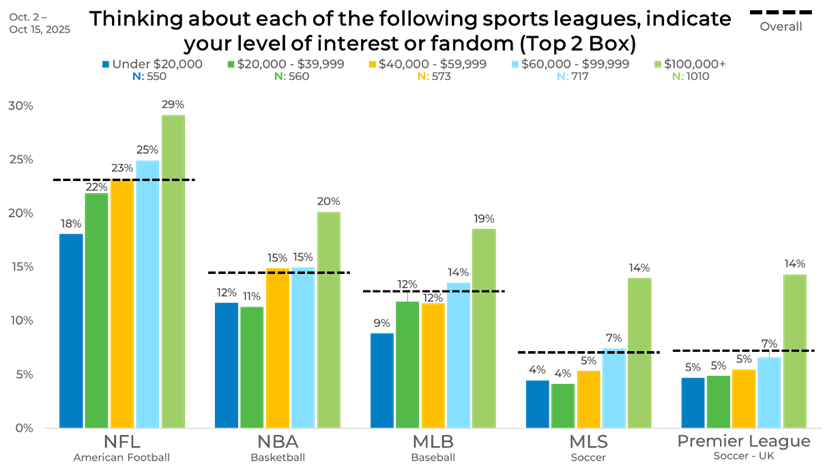
Income levels further distinguish fandom intensity across sports. NFL fandom grows steadily with income, climbing from 18% among those earning under $20,000 to 29% at the $100,000+ level. The NBA, MLB, and both soccer leagues follow similar trajectories, with interest rising among higher earners. Notably, soccer sees its largest jumps at the top income tiers, where both MLS and Premier League fandom double or triple compared with lower-income respondents.
Political Affiliation
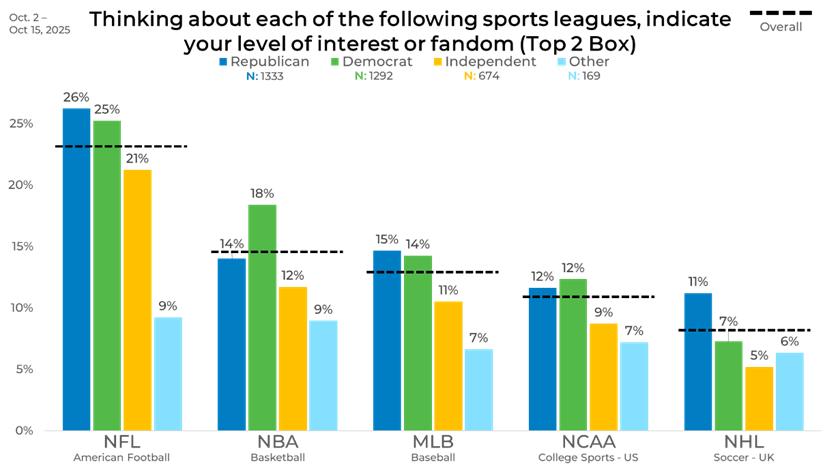
Political affiliation also aligns with noticeable differences in sports preferences. Republicans and Democrats display similar enthusiasm for football, both hovering near one-quarter fandom, while Independents trail slightly at 21%. The NBA leans higher among Democrats, at 18%, compared with 14% of Republicans. Meanwhile, Republicans show more affinity for hockey, at 11%, a rate notably higher than other groups. Across the board, partisanship appears to influence which leagues capture attention, though not the overall presence of sports engagement.
Region
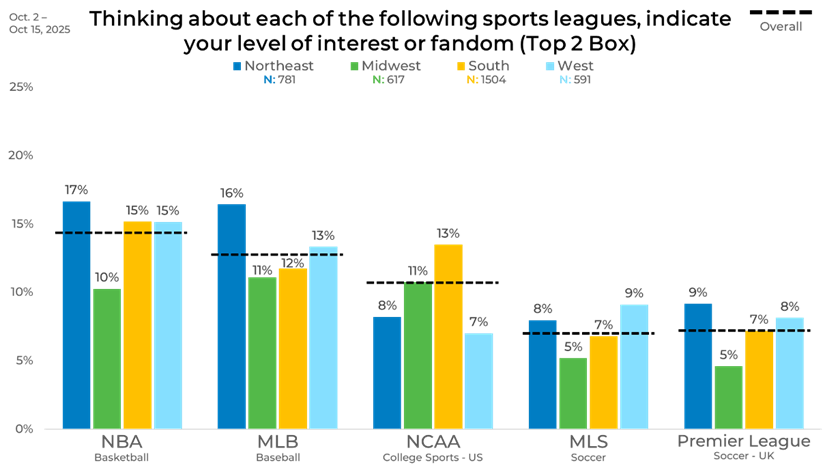
Regional variations help illustrate where each sport finds its strongest base. Basketball fandom peaks in the Northeast at 17%, while baseball maintains its highest engagement there as well. College sports, however, reach their top interest levels in the South at 13%, reflecting the region’s deep college athletics tradition. Soccer, both MLS and the Premier League, see relatively higher fandom in the West and Northeast, areas where diverse communities may contribute to broader exposure.
Ethnicity
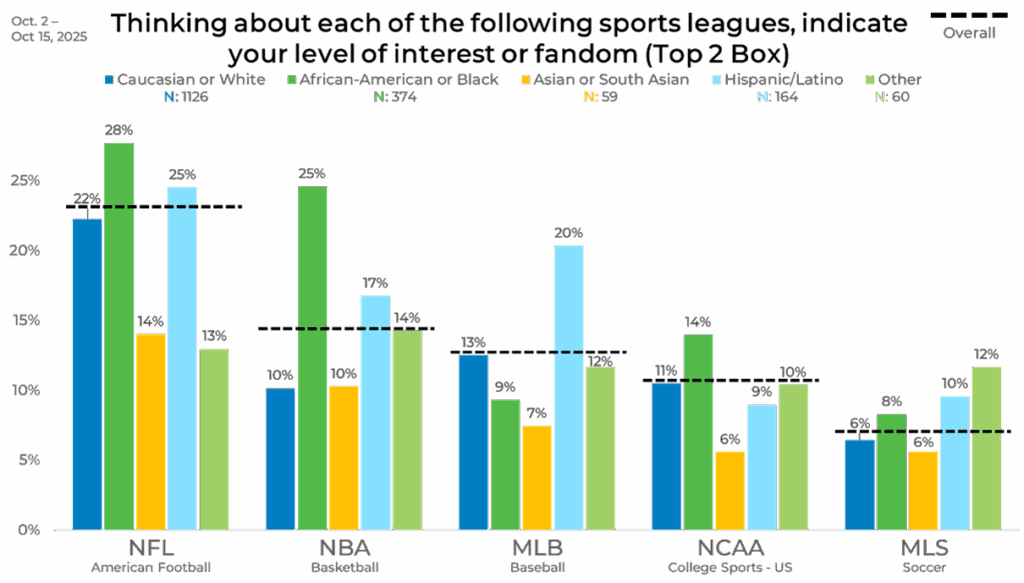
When looking at the data by ethnicity, there were some distinct trends that emerged. African American respondents show high engagement with both football (28%) and basketball (25%), standing well above the general population. Hispanic/Latino respondents lead in baseball fandom at 20% and also report above-average soccer interest. Caucasian respondents remain most engaged with football and baseball, while Asian respondents maintain lower but consistent engagement across most leagues.
Panel
Panel results show how blending multiple data sources creates a more complete picture of fandom. Panel O records the highest NFL enthusiasm at 31%, compared to just 13% in Panel I, a notable gap between groups. Basketball ranges from 9% in Panel I to 20% in Panel O, while MLB climbs from 8% to 16% across the same panels.
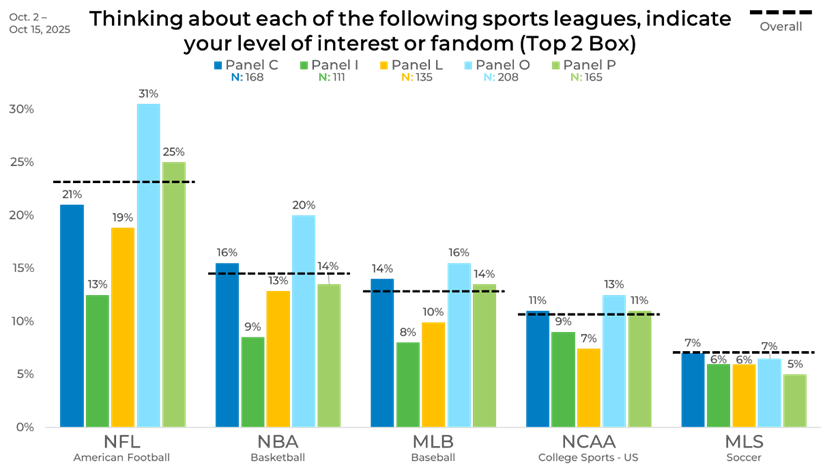
These results highlight how panel bias can impact your data if you are not utilizing strategic sample blending on your studies. To learn more about how you can implement strategic blending on your next project, click the button below.