

3 Time-Saving Tips for Small Consumer Research Teams
February 4, 2026
A Look into the Crystal Ball: A Five Year Outlook on Consumer Economic Sentiment
February 9, 2026
One of the better criteria that people incorporate into their financial outlook is business conditions. Business conditions lead to predictions on job growth or decline, increased or decreases in spending, and more. In part three of our series on consumer financial sentiment, we explore how US consumers view the financial direction of national business conditions.
Let’s jump in.
Overall
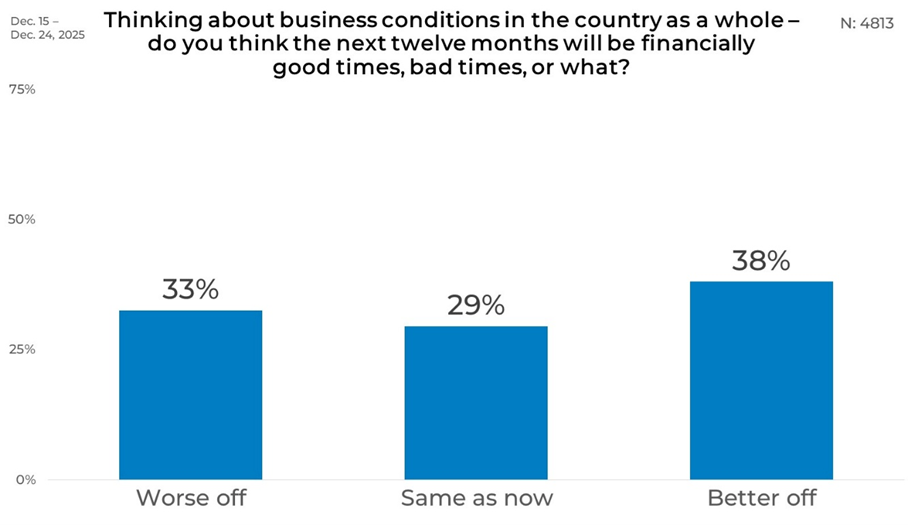
Overall, expectations are mixed. Thirty-eight percent say they expect good financial times over the next year, while one-third (33%) anticipate bad times. Just under three in ten (29%) believe conditions will remain about the same as they are now.
Gender
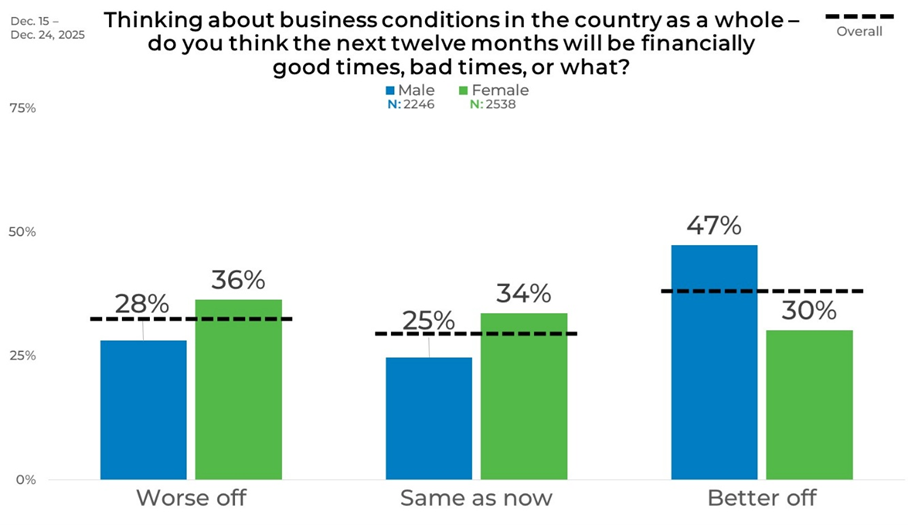
Men are more likely than women to express optimism about the coming year. Nearly half of men (47%) say they expect good times financially, compared with 30% of women. Women are more likely to anticipate bad times, with 36% holding this view versus 28% of men. Women are also more inclined to say conditions will stay the same (34%) compared with men (25%).
Age
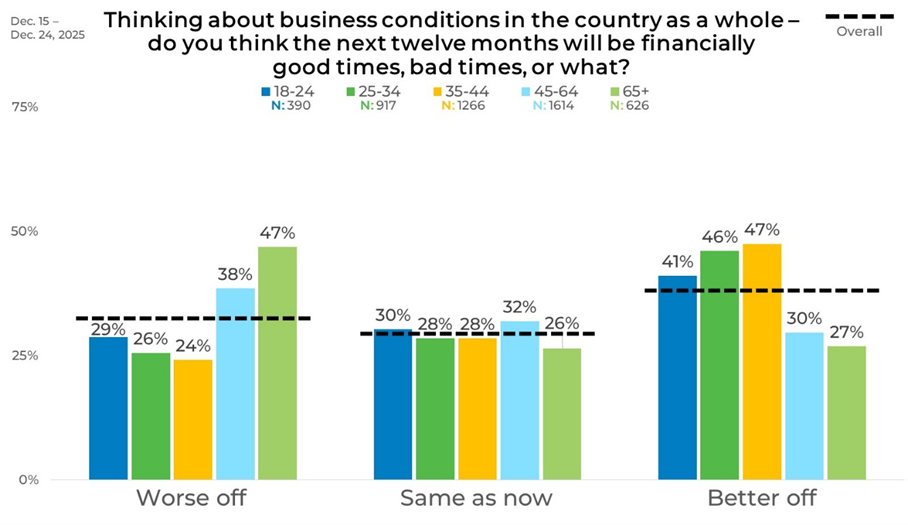
Breaking down the data by age found that younger adults were generally more optimistic than older groups. Among those ages 18–24, 41% expect good times, compared with 29% who expect bad times. Optimism increases further among those ages 25–34 and 35–44, where roughly mid-to-high forties percentages expect good times. Expectations shift among older adults: 45–64-year-olds are more likely to anticipate bad times (38%) than good times (30%), and among those 65 and older, nearly half (47%) expect bad times, while 27% expect good times.
Income
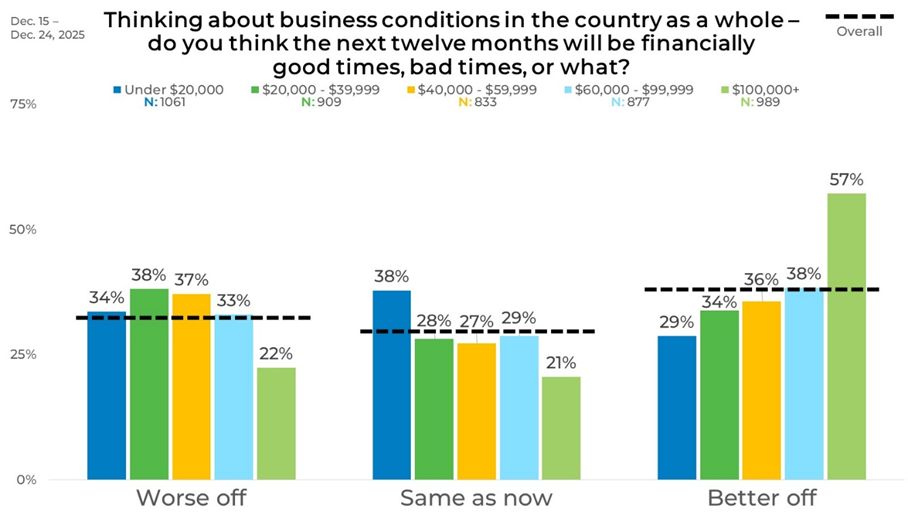
Expectations around business conditions for the coming year vary consistently with income. Respondents with household incomes under $20,000 are more likely to say conditions will stay the same (38%) or get worse (34%) than improve (29%). Optimism increases with income, culminating among those earning $100,000 or more, where 57% expect good times and 22% anticipate bad times. Middle-income groups fall between these ends, with gradually rising expectations of good times as income increases.
Political Affiliation
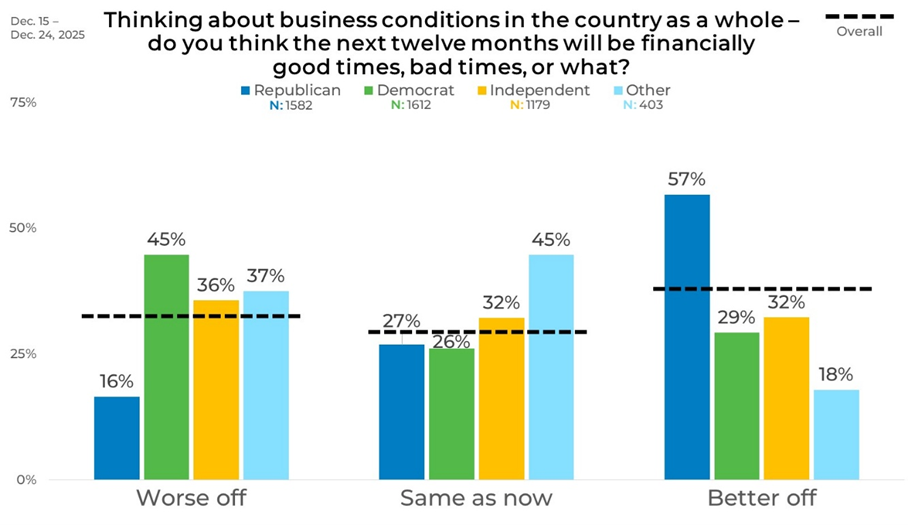
The outlook around national business conditions differ notably by political affiliation. A majority of Republicans (57%) expect good times financially, while 16% foresee bad times. Among Democrats, expectations are more negative, with 45% anticipating bad times and 29% expecting good times. Independents are more evenly divided, with 36% saying bad times, 32% saying good times, and 32% expecting conditions to stay the same. Respondents identifying with other affiliations most often say conditions will stay the same (45%), while fewer anticipate good times (18%).
Panel
When looking at the data by panel, there are notable variations in climate expectations. The largest contrast appears between Panel L and Panel A. In Panel L, a majority (53%) expect good times and 25% anticipate bad times, while Panel A shows the opposite pattern, with 43% expecting bad times and just 22% expecting good times. Panels G, Q, and X fall between these two endpoints, with more evenly distributed views across the three response options.
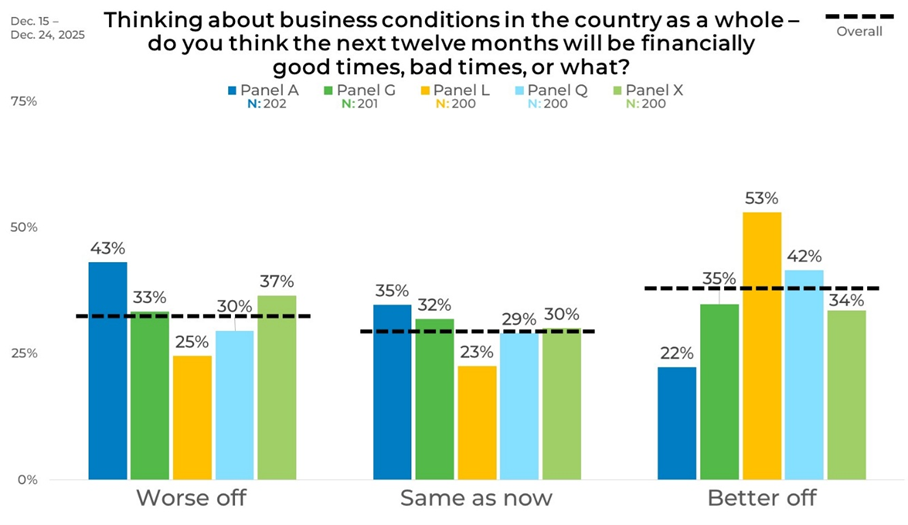
This data highlights the need to understand the attitudes and behaviors of your sample sources as you select them for your studies. Picking the wrong combination can lead to misleading insights, and ultimately, the wrong decision.
Learn about how EMI’s strategic sample blending approach can help.