

Tariff Nation: What Americans Know and How They Feel
July 29, 2025
Pinning Down Public Perception: MaxDiff vs. Like Order
August 11, 2025
With rising trade tensions dominating headlines, many Americans have taken note of tariffs and their potential effects. Our two-part series on tariffs is attempting to understand the public’s perspective on these domestic changes and how it affects their day-to-day lives. The first part of our series, “Tariff Nation: What Americans Know and How They Feel” (which you can check out here), asked participants if they were aware of changing tariff policy and if they supported it. For the second part of our series, the question detailed below was posed only to those who said they were aware of the current tariffs. Among this informed group, concern about their impact on the U.S. economy appears widespread, revealing important differences in perception across gender, political affiliation, and other demographics.
Overall
Overall, of respondents who were aware of the tariffs, nearly half say they are “very concerned” about their economic impact, while another 36% are “somewhat concerned.” Only 17% fall into the less-concerned categories, with just 5% saying they’re “not concerned at all.”

Gender
Men and women show similar levels of concern, though women are slightly more likely to express heightened worry. Forty-nine percent of female respondents are “very concerned,” compared to 46% of males. Both genders report equal levels of being “somewhat concerned” (36%), while men are more likely to say they are “not concerned at all.”

Age
Age plays a modest role in shaping opinions. Younger adults, particularly those 18 to 34, report slightly lower levels of extreme concern compared to those aged 35 to 64. Notably, concern peaks among those 35 to 44, where half report being “very concerned.” Seniors aged 65 and older report slightly higher rates of being unconcerned, with 7% saying they are “not concerned at all.”

Income
Perspectives on tariffs are relatively consistent across income levels. A consensus reflecting high-level concern is shared between income groups, with the difference between the highest group ($100,000+) and lowest (under $20,000) never differing by more than 8%. Overall, participants with income ranging from $20,000-$39,999 report the least amount of concern, totaling 82%, while the lowest income group (under $20,000) reports the highest amount of concern with 87% choosing either “Somewhat concerned’ or “Very concerned”.

Political Affiliation
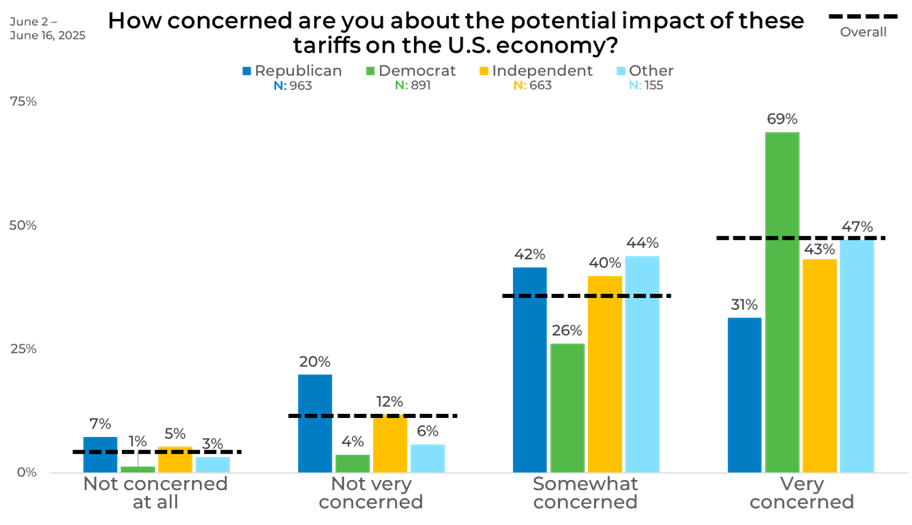
Political identity strongly influences perceptions. Among Democrats, a striking 69% are “very concerned,” the highest of any group. Republicans, by contrast, show significantly lower concern: just 31% fall in the “very concerned” category, while 27% are either “not very” or “not at all concerned.” Independents and those identifying as “Other” lean more toward concern, though not as sharply as Democrats.
Region
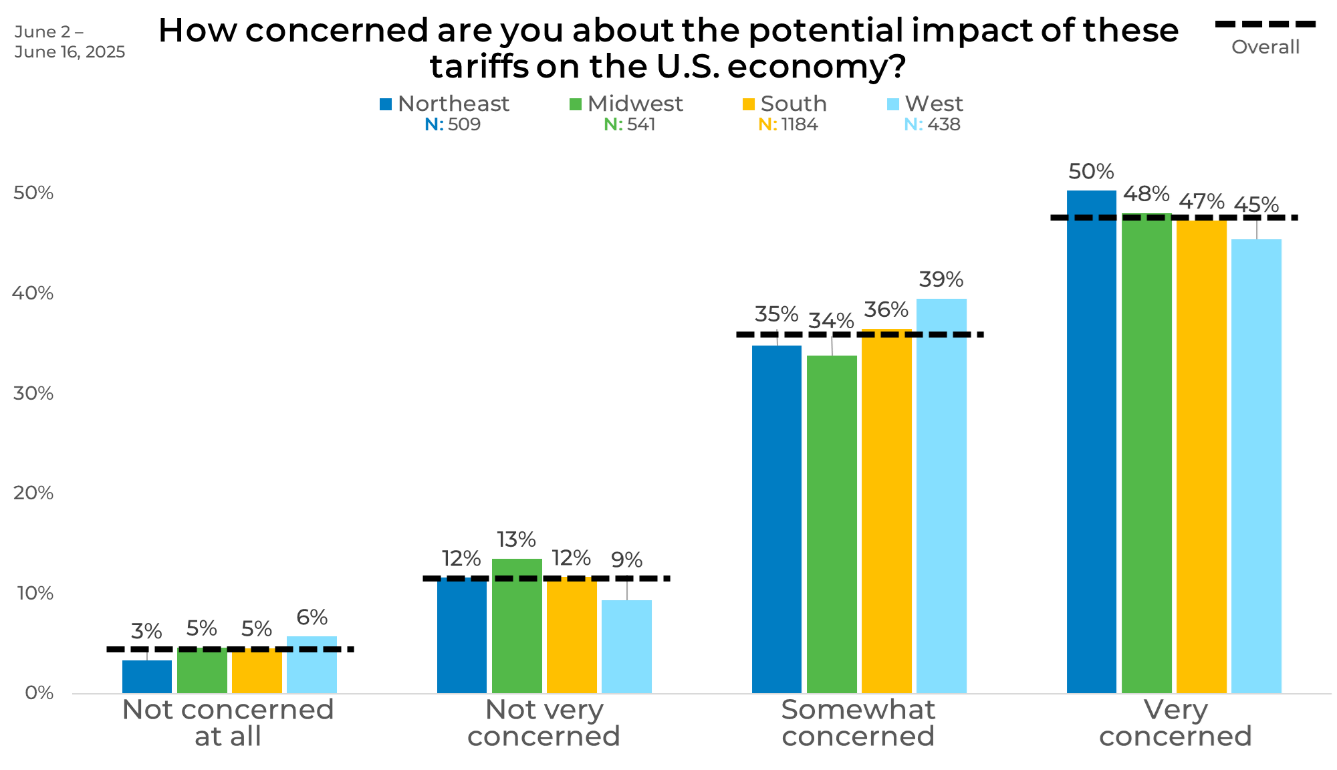
Regional patterns are relatively stable, with all areas showing a majority expressing concern. The Northeast leads slightly with 50% “very concerned,” followed closely by the Midwest, South, and West. Minor variations in lower concern levels across regions suggest geographical location has minimal influence on attitudes.
Ethnicity
Ethnicity also shapes perspectives. African-American respondents report the highest concern, with 54% “very concerned,” while Asian or South Asian respondents are most likely to fall in the “somewhat concerned” group (46%). Caucasian and Hispanic/Latino groups align closely with overall averages, while respondents identifying as “Other” also show strong levels of concern.

Panel
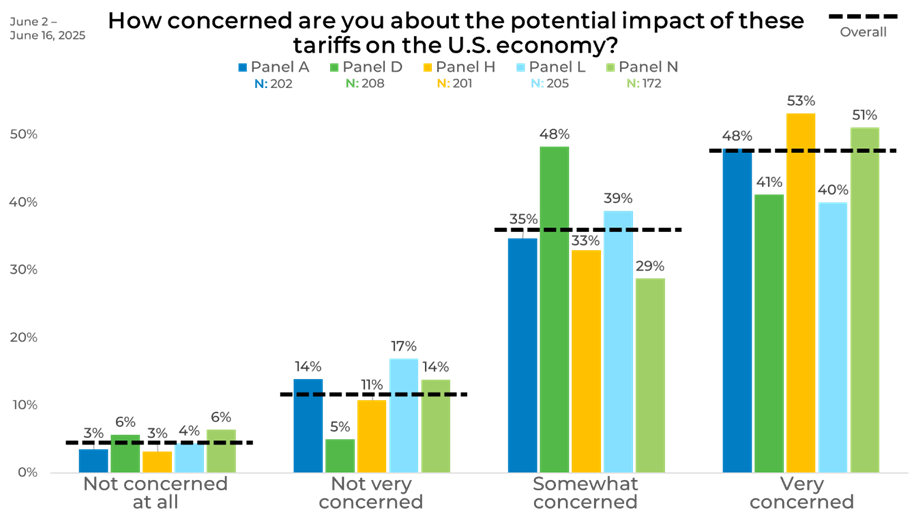
Panel results highlight notable differences in response patterns. Panel H shows the highest level of deep concern at 53%, while Panel D has the lowest at 41% and also leads in moderate concern (48%). Panel L stands out for the highest share of “not very concerned” responses at 17%. Panel N also leans toward concern, with 51% “very concerned.”
To learn more about how EMI’s strategic sample blending can ensure high-quality conclusions from your next survey, click the button below.