

More AI-Backed Tools and the Impact of Proposed Census Changes
March 24, 2026
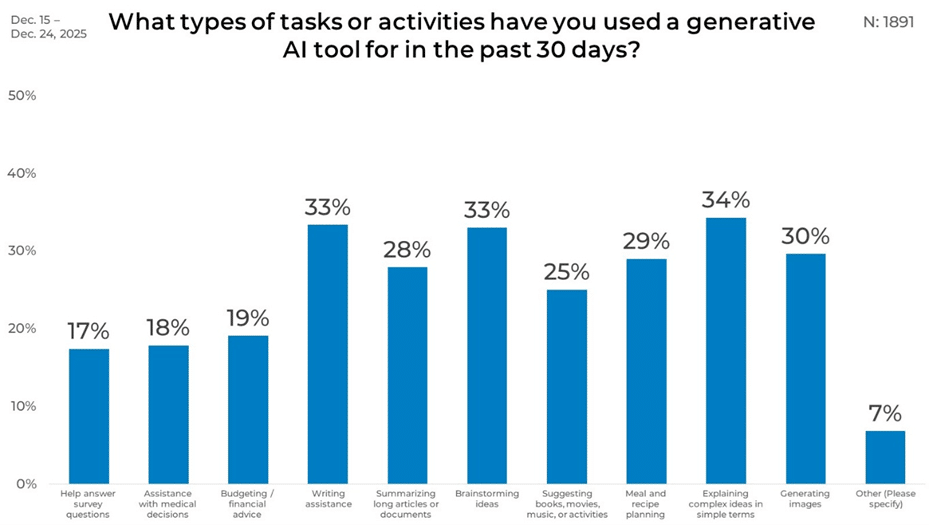
When the age of LLMs started, most people used it to write funny songs in the style of their favorite singer, or quickly summarize long documents. Fast forward to the present, US consumers are using LLMs for a variety of tasks, from brainstorming ideas to getting medical advice. In our recent wave of research-on-research, we asked respondents who have used generative AI in the last month what activities they used it for.
Let’s dive in:
Overall
The most common uses of generative AI among US consumers centers on understanding and creating content. Explaining complex ideas in simple terms leads at 34%, followed closely by writing assistance and brainstorming ideas, both at 33%. Generating images (30%), meal and recipe planning (29%), and summarizing long articles or documents (28%) also represent common activities.
Gender
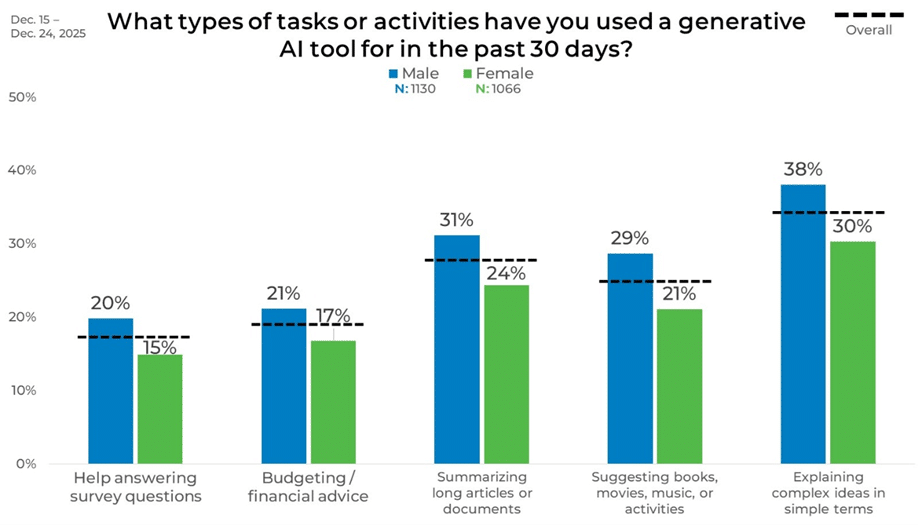
A higher percentage of males have used generative AI for the listed tasks than females. For example, 38% of males report using AI to explain complex ideas in simple terms, compared with 30% of females. A similar gap appears in summarizing long articles or documents (31% vs. 24%) and suggesting books, movies, music, or activities (29% vs. 21%).
Age
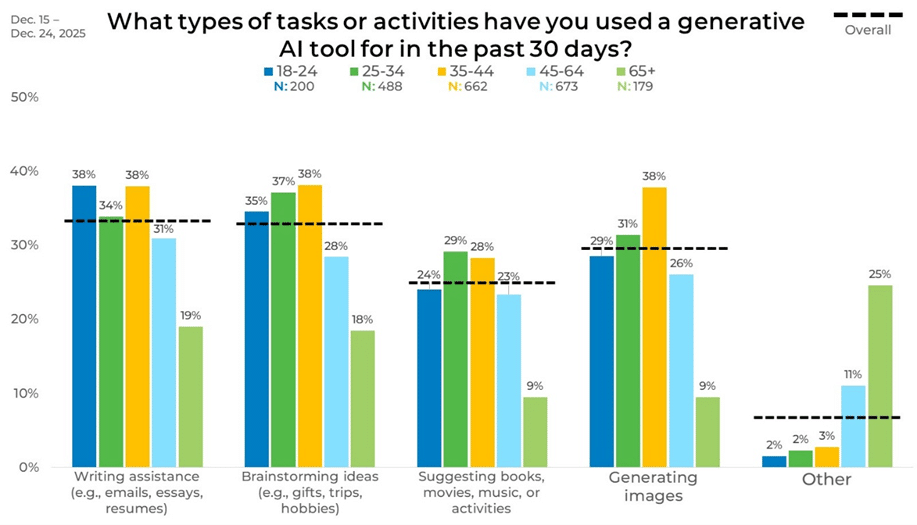
Segmenting the data by age shows higher usage among younger consumers across several activities. Writing assistance peaks among those aged 18–24 and 35–44 (both 38%), followed by 25–34 (34%), then declines to 31% among 45–64 and 19% among those 65+.
Brainstorming ideas follows a similar pattern, peaking at 38% among 35–44 and 37% among 25–34, then dropping to 28% among 45–64 and 18% among 65+. Generating images is also higher among younger and middle-aged groups, reaching 38% among 35–44 and 31% among 25–34, compared with 9% among those 65+.
Income
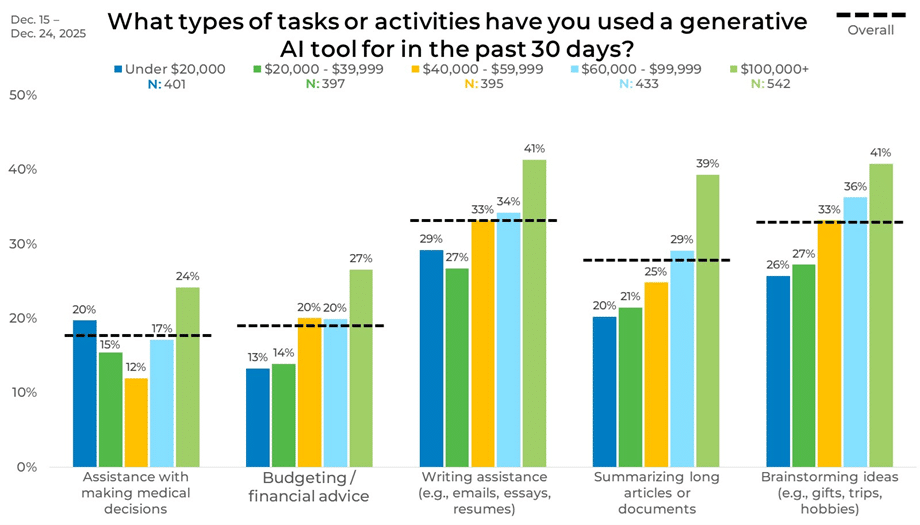
For most tasks, the use of generative AI increases with income. Writing assistance grows from 29% among those earning under $20,000 to 41% among those earning $100,000 or more. A similar upward trend appears in summarizing long articles or documents, increasing from 20% to 39%, and brainstorming ideas, rising from 26% to 41%.
Region
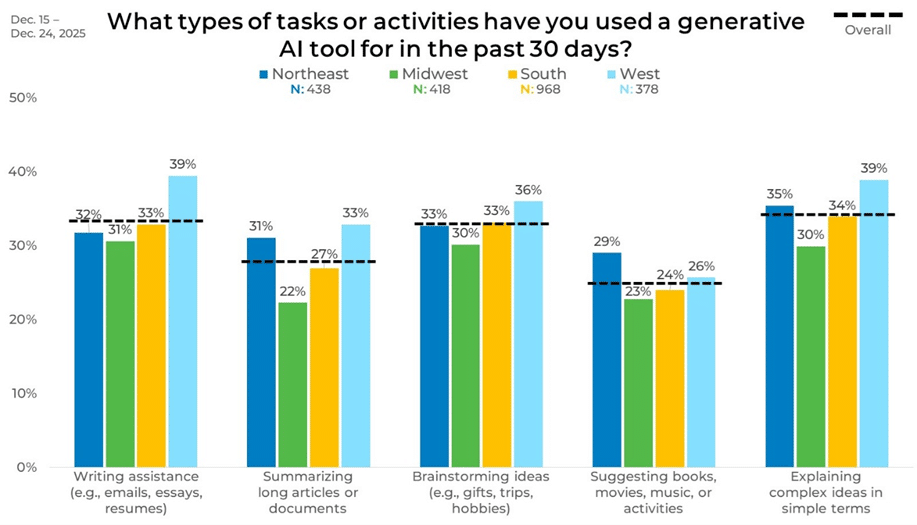
Some regional differences in the activities generative AI is used for appears when breaking the data down by geography. The West stands out with the highest reported usage for writing assistance at 39% and explaining complex ideas in simple terms at 39%, both exceeding other regions. Brainstorming ideas is relatively consistent across regions, ranging from 30% in the Midwest to 36% in the West.
Panel
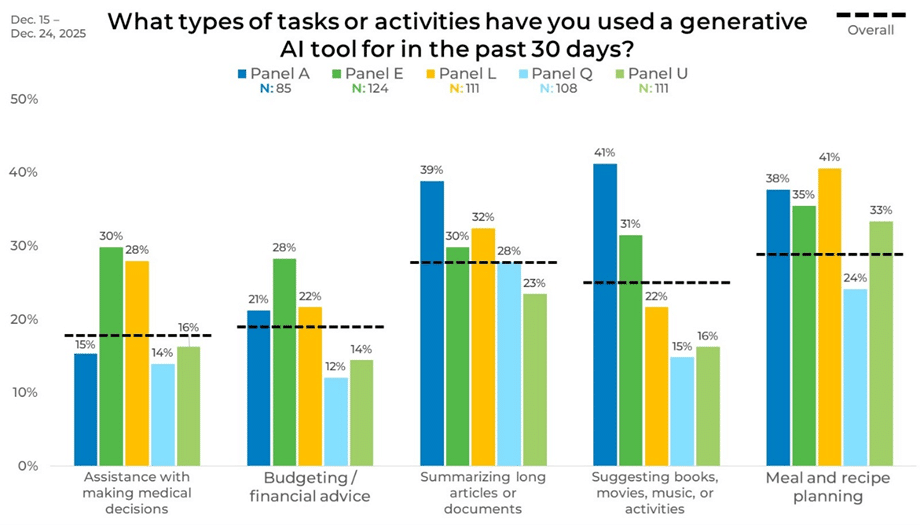
The data by panel source underscores some clear variations in what generative AI is being used for. Assistance with making medical decisions ranges from 30% in Panel E and 28% in Panel L down to 14–16% in Panels Q, A, and U, while budgeting or financial advice spans from 28% in Panel E to 12% in Panel Q.
Suggesting books, movies, music, or activities shows one of the widest spreads, from 41% in Panel A to 15–16% in Panels Q and U. Summarizing long articles also varies notably, led by Panel A (39%) and dropping to 23% in Panel U. Meal and recipe planning peaks at 41% in Panel L, compared with 24% in Panel Q, further highlighting differences across panels.
This is a good reminder that how you build your sample really matters. Strategic blending helps avoid the bias that can sneak in when you don’t understand the attitudes and behaviors of the panels you use.