

Fraud Detection Consolidation and a New CEO for the Insights Association
February 12, 2026
The Modern Faith Map: Religion in America
February 20, 2026
Food, shelter, and healthcare. These are some of the basic human needs. For many US consumers, our healthcare choices start with our health insurance provider. We wanted to understand which providers consumers are using, so we asked in our most recent round of research-on-research.
Let’s see what we found:
Overall
Overall, Blue Cross Blue Shield is the most commonly used health insurance, with 31% of respondents reporting its use. UnitedHealthcare ranked second at 25%. Together, these two providers account for more than half of reported usage. Aetna is cited by 15% of respondents, placing it in a clear third position, while Cigna Healthcare and Humana each register at 11%, forming a closely grouped middle tier. Health Care Services Corporation and Kaiser Permanente are each reported at 6%, and Centene Corp and Elevance Health each account for 4%, representing smaller shares of usage. At the same time, nearly one in five respondents (18%) select Other providers, and 10% prefer not to answer.

Age
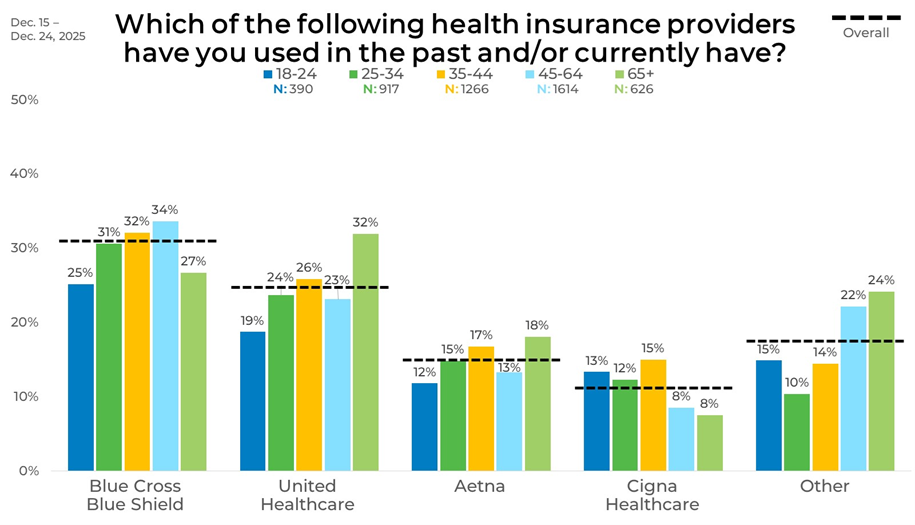
Looking at the data by age groups, Blue Cross Blue Shield usage generally rises from younger to middle-aged groups, moving from 25% among ages 18–24 to a peak of 34% among ages 45–64, before declining to 27% among those 65 and older. United Healthcare shows a different pattern, reaching its highest level among respondents aged 65+ at 32%, compared with 19% among the youngest group.
Aetna’s highest usage also appears among those 65+ at 18%, while Cigna Healthcare is more concentrated among younger and middle-aged adults, peaking at 15% among ages 35–44 and falling to 8% among those 45 and older. Selection of Other providers increases notably in later age groups, rising to 22% among ages 45–64 and 24% among those 65+, compared with 10% to 15% among younger respondents.
Income
Income levels show a clear upward pattern for several major providers. Blue Cross Blue Shield increases steadily from 21% among those earning under $20,000 to 40% among those earning $100,000 or more. United Healthcare follows a similar, though more gradual, rise from 20% in the lowest income group to 30% in the highest.
Aetna and Cigna Healthcare also both expand their share as income increases, with Aetna moving from 11% to 22% and Cigna from 7% to 20%. In contrast, selection of Other providers declines consistently as income rises, dropping from 26% in the lowest income bracket to 9% among the highest earners, indicating a shift toward named insurers at higher income levels.

Political Affiliation
Across the political spectrum, Blue Cross Blue Shield holds an identical 34% among both Republican and Democrat respondents. United Healthcare follows a similar ordering, highest among Republicans at 28%, then Independents at 25%, Democrats at 23%, and lowest among the Other category at 16%.
Across Aetna and Cigna Healthcare, usage steadily declines from Republicans to Democrats to Independents and then to the Other category, with Aetna ranging from 18% to 8% and Cigna from 14% to 6%. Meanwhile, selection of Other providers increases among Independents (22%) and those in the Other political category (23%), compared with Republicans (14%) and Democrats (16%), reflecting a comparatively higher share outside the largest named insurers in those groups.

Ethnicity
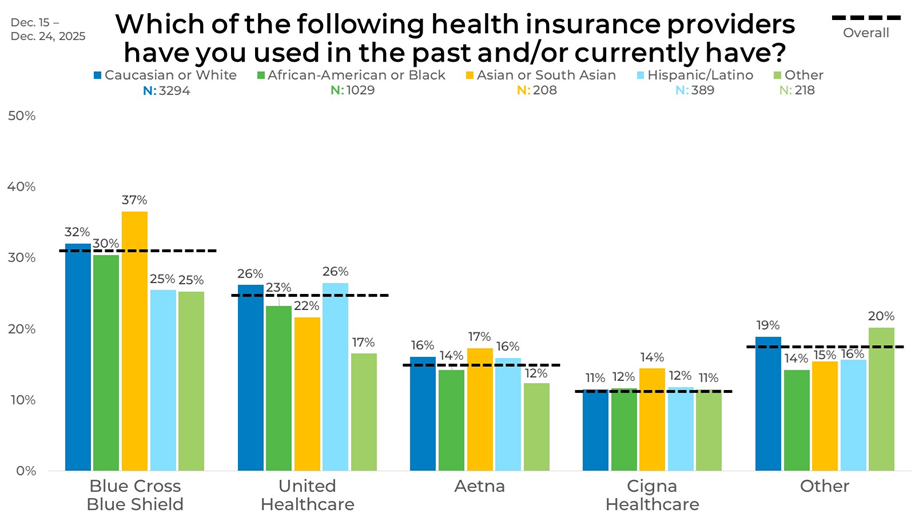
Blue Cross Blue Shield reports its highest usage among Asian or South Asian respondents at 37%, followed by Caucasian or White (32%) and African American or Black respondents (30%), while Hispanic/Latino and those identifying as Other each register 25%.
United Healthcare clusters in the low-to-mid 20s across most groups (26% among Caucasian or White and Hispanic/Latino respondents, 23% among African American or Black respondents, and 22% among Asian or South Asian respondents) before dropping to 17% among those identifying as Other. Aetna ranges from 12% to 17% across groups, and Cigna Healthcare remains steady between 11% and 14%.
Panel
The data by panel source shows noticeable variation in concentration around the largest providers. Blue Cross Blue Shield ranges from 23% in Panel B to 43% in Panel R, a 20-point spread that represents the largest difference observed across panels for any provider. United Healthcare also varies, reaching 35% in Panel R and falling to 22% in Panel M.
Aetna and Cigna Healthcare move within narrower ranges, though Panel E reports comparatively higher usage for both 21% and 17% respectively. Selection of Other providers spans from 12% in Panel B to 19% in Panel M, reflecting more moderate differences compared with the gap seen for Blue Cross Blue Shield.

This data highlights the need for careful selection in sample providers for online studies. Selecting the wrong mix can bias your data and lead to the wrong decision. Click the button below to learn how EMI can help you create the right blend of providers for your next study.